Shark Attacks The correlation between the number of visitors to the state of Florida and the number of shark attacks since 1990 is 0.946. Should the number of visitors to Florida be reduced in an attempt to reduce shark attacks? Explain your reasoning.
Table of contents
- 1. Intro to Stats and Collecting Data1h 14m
- 2. Describing Data with Tables and Graphs1h 56m
- 3. Describing Data Numerically2h 5m
- 4. Probability2h 17m
- 5. Binomial Distribution & Discrete Random Variables3h 6m
- 6. Normal Distribution and Continuous Random Variables2h 11m
- 7. Sampling Distributions & Confidence Intervals: Mean3h 23m
- Sampling Distribution of the Sample Mean and Central Limit Theorem19m
- Distribution of Sample Mean - ExcelBonus23m
- Introduction to Confidence Intervals15m
- Confidence Intervals for Population Mean1h 18m
- Determining the Minimum Sample Size Required12m
- Finding Probabilities and T Critical Values - ExcelBonus28m
- Confidence Intervals for Population Means - ExcelBonus25m
- 8. Sampling Distributions & Confidence Intervals: Proportion2h 10m
- 9. Hypothesis Testing for One Sample5h 8m
- Steps in Hypothesis Testing1h 6m
- Performing Hypothesis Tests: Means1h 4m
- Hypothesis Testing: Means - ExcelBonus42m
- Performing Hypothesis Tests: Proportions37m
- Hypothesis Testing: Proportions - ExcelBonus27m
- Performing Hypothesis Tests: Variance12m
- Critical Values and Rejection Regions28m
- Link Between Confidence Intervals and Hypothesis Testing12m
- Type I & Type II Errors16m
- 10. Hypothesis Testing for Two Samples5h 37m
- Two Proportions1h 13m
- Two Proportions Hypothesis Test - ExcelBonus28m
- Two Means - Unknown, Unequal Variance1h 3m
- Two Means - Unknown Variances Hypothesis Test - ExcelBonus12m
- Two Means - Unknown, Equal Variance15m
- Two Means - Unknown, Equal Variances Hypothesis Test - ExcelBonus9m
- Two Means - Known Variance12m
- Two Means - Sigma Known Hypothesis Test - ExcelBonus21m
- Two Means - Matched Pairs (Dependent Samples)42m
- Matched Pairs Hypothesis Test - ExcelBonus12m
- Two Variances and F Distribution29m
- Two Variances - Graphing CalculatorBonus16m
- 11. Correlation1h 24m
- 12. Regression3h 33m
- Linear Regression & Least Squares Method26m
- Residuals12m
- Coefficient of Determination12m
- Regression Line Equation and Coefficient of Determination - ExcelBonus8m
- Finding Residuals and Creating Residual Plots - ExcelBonus11m
- Inferences for Slope31m
- Enabling Data Analysis ToolpakBonus1m
- Regression Readout of the Data Analysis Toolpak - ExcelBonus21m
- Prediction Intervals13m
- Prediction Intervals - ExcelBonus19m
- Multiple Regression - ExcelBonus29m
- Quadratic Regression15m
- Quadratic Regression - ExcelBonus10m
- 13. Chi-Square Tests & Goodness of Fit2h 21m
- 14. ANOVA2h 29m
1. Intro to Stats and Collecting Data
Intro to Stats
Problem 1.1.57
Textbook Question
The age of a person is commonly considered to be a continuous random variable. Could it be considered a discrete random variable instead? Explain.
Verified step by step guidance1
Step 1: Understand the definitions of discrete and continuous random variables. A discrete random variable takes on countable values, often integers, such as the number of students in a class. A continuous random variable can take any value within an interval, such as height or weight.
Step 2: Consider the nature of age as a measurement. Age can be measured very precisely (e.g., in years, months, days, hours, or even seconds), which means it can take on infinitely many values within a range, suggesting it is continuous.
Step 3: Reflect on practical measurement limitations. Although age is theoretically continuous, in many real-world contexts, age is recorded in whole years, making it appear discrete because only integer values are used.
Step 4: Conclude that while age is fundamentally a continuous random variable due to its potential for infinite precision, it can be treated as discrete in specific contexts where only whole number ages are considered.
Step 5: Summarize that the classification depends on the level of measurement precision: continuous in theory, but sometimes modeled as discrete for simplicity or practicality.
Verified video answer for a similar problem:This video solution was recommended by our tutors as helpful for the problem above
Video duration:
4mPlay a video:
0 Comments
Key Concepts
Here are the essential concepts you must grasp in order to answer the question correctly.
Continuous vs. Discrete Random Variables
Random variables are classified as continuous if they can take any value within an interval, and discrete if they take countable, distinct values. Age is typically continuous because it can be measured with infinite precision (e.g., years, months, seconds).
Recommended video:
Guided course
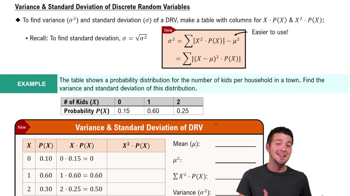
Variance & Standard Deviation of Discrete Random Variables
Measurement Precision and Practical Discretization
Although age is theoretically continuous, in practice it is often recorded in discrete units like whole years or months. This practical discretization can make age appear discrete, but the underlying variable remains continuous.
Recommended video:
Guided course
Variance & Standard Deviation of Discrete Random Variables
Implications for Statistical Modeling
Treating age as continuous or discrete affects the choice of probability models and analysis methods. Continuous models use probability density functions, while discrete models use probability mass functions, influencing how data is interpreted and analyzed.
Recommended video:
Guided course
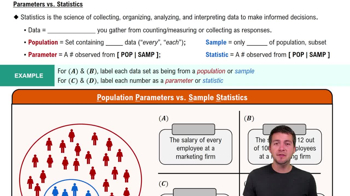
Parameters vs. Statistics
Related Videos
Related Practice
Textbook Question
30
views