Putting It Together: Lupus Based on historical birthing records, the proportion of males born worldwide is 0.51. In other words, the commonly held belief that boys are just as likely as girls is false. Systematic lupus erythematosus (SLE), or lupus for short, is a disease in which one’s immune system attacks healthy cells and tissue by mistake. It is well known that lupus tends to exist more in females than in males. Researchers wondered, however, if families with a child who had lupus had a lower ratio of males to females than the general population. If this were true, it would suggest that something happens during conception that causes males to be conceived at a lower rate when the SLE gene is present. To determine if this hypothesis is true, the researchers obtained records of families with a child who had SLE. A total of 23 males and 79 females were found to have SLE. The 23 males with SLE had a total of 23 male siblings and 22 female siblings. The 79 females with SLE had a total of 69 male siblings and 80 female siblings. f. Does the sample evidence suggest that the proportion of male siblings in families where one of the children has SLE is less than 0.51, the accepted proportion of males born in the general population? Use the α = 0.05 level of significance.
Verified step by step guidance
1
Step 1: Define the parameter of interest. Here, we want to test whether the proportion of male siblings in families with a child who has SLE is less than 0.51, the known proportion of males born in the general population. Let \(p\) represent the true proportion of male siblings in these families.
Step 2: Calculate the sample proportion of male siblings. Combine the number of male siblings and female siblings from both groups (males with SLE and females with SLE) to find the total number of siblings and the total number of male siblings. Then compute the sample proportion \(\hat{p} = \frac{\text{number of male siblings}}{\text{total number of siblings}}\).
Step 3: State the hypotheses for the test. The null hypothesis \(H_0\) assumes the proportion of male siblings is equal to 0.51: \(H_0: p = 0.51\). The alternative hypothesis \(H_a\) is that the proportion is less than 0.51: \(H_a: p < 0.51\).
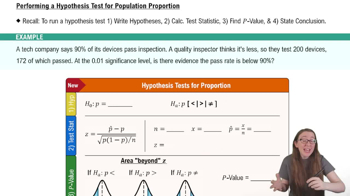
Step 4: Calculate the test statistic using the formula for a one-proportion z-test:
\[
z = \frac{\hat{p} - p_0}{\sqrt{\frac{p_0 (1 - p_0)}{n}}}
\]
where \(p_0 = 0.51\) is the population proportion under the null hypothesis, \(\hat{p}\) is the sample proportion, and \(n\) is the total number of siblings.
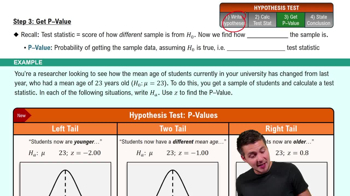
Step 5: Determine the critical value or p-value for the test at the \(\alpha = 0.05\) significance level for a left-tailed test. Compare the test statistic to the critical value or compare the p-value to \(\alpha\). If the test statistic is less than the critical value or the p-value is less than \(\alpha\), reject the null hypothesis, concluding that the proportion of male siblings is significantly less than 0.51.
Verified video answer for a similar problem:
This video solution was recommended by our tutors as helpful for the problem above
Video duration:
9m
Play a video:
0 Comments
Key Concepts
Here are the essential concepts you must grasp in order to answer the question correctly.
Hypothesis Testing for Proportions
Hypothesis testing for proportions involves comparing a sample proportion to a known population proportion to determine if there is significant evidence to support a claim. It requires setting up a null hypothesis (usually stating no difference) and an alternative hypothesis (indicating a difference or direction). The test uses sample data to calculate a test statistic and p-value to decide whether to reject the null hypothesis at a given significance level.
The significance level, α, is the threshold probability for rejecting the null hypothesis, commonly set at 0.05. The p-value measures the probability of observing the sample data, or something more extreme, assuming the null hypothesis is true. If the p-value is less than α, the null hypothesis is rejected, indicating statistically significant evidence in favor of the alternative hypothesis.
When analyzing family data, it is important to consider whether observations (siblings) are independent and representative of the population. Dependence among siblings or selection bias can affect the validity of statistical tests. Proper aggregation or adjustment may be needed to ensure the sample proportion accurately reflects the population parameter being tested.

 9:46 minutes
 Verified step by step guidance
 05:52
05:52