A research center claims that more than 80% of U.S. adults think that mothers should have paid maternity leave. In a random sample of 50 U.S. adults, 82% think that mothers should have paid maternity leave. At α=0.05, is there enough evidence to support the center’s claim?
Table of contents
- 1. Intro to Stats and Collecting Data1h 14m
- 2. Describing Data with Tables and Graphs1h 56m
- 3. Describing Data Numerically2h 5m
- 4. Probability2h 16m
- 5. Binomial Distribution & Discrete Random Variables3h 6m
- 6. Normal Distribution and Continuous Random Variables2h 11m
- 7. Sampling Distributions & Confidence Intervals: Mean3h 23m
- Sampling Distribution of the Sample Mean and Central Limit Theorem19m
- Distribution of Sample Mean - Excel23m
- Introduction to Confidence Intervals15m
- Confidence Intervals for Population Mean1h 18m
- Determining the Minimum Sample Size Required12m
- Finding Probabilities and T Critical Values - Excel28m
- Confidence Intervals for Population Means - Excel25m
- 8. Sampling Distributions & Confidence Intervals: Proportion2h 10m
- 9. Hypothesis Testing for One Sample5h 8m
- Steps in Hypothesis Testing1h 6m
- Performing Hypothesis Tests: Means1h 4m
- Hypothesis Testing: Means - Excel42m
- Performing Hypothesis Tests: Proportions37m
- Hypothesis Testing: Proportions - Excel27m
- Performing Hypothesis Tests: Variance12m
- Critical Values and Rejection Regions28m
- Link Between Confidence Intervals and Hypothesis Testing12m
- Type I & Type II Errors16m
- 10. Hypothesis Testing for Two Samples5h 37m
- Two Proportions1h 13m
- Two Proportions Hypothesis Test - Excel28m
- Two Means - Unknown, Unequal Variance1h 3m
- Two Means - Unknown Variances Hypothesis Test - Excel12m
- Two Means - Unknown, Equal Variance15m
- Two Means - Unknown, Equal Variances Hypothesis Test - Excel9m
- Two Means - Known Variance12m
- Two Means - Sigma Known Hypothesis Test - Excel21m
- Two Means - Matched Pairs (Dependent Samples)42m
- Matched Pairs Hypothesis Test - Excel12m
- Two Variances and F Distribution29m
- Two Variances - Graphing Calculator16m
- 11. Correlation1h 24m
- 12. Regression3h 33m
- Linear Regression & Least Squares Method26m
- Residuals12m
- Coefficient of Determination12m
- Regression Line Equation and Coefficient of Determination - Excel8m
- Finding Residuals and Creating Residual Plots - Excel11m
- Inferences for Slope31m
- Enabling Data Analysis Toolpak1m
- Regression Readout of the Data Analysis Toolpak - Excel21m
- Prediction Intervals13m
- Prediction Intervals - Excel19m
- Multiple Regression - Excel29m
- Quadratic Regression15m
- Quadratic Regression - Excel10m
- 13. Chi-Square Tests & Goodness of Fit2h 21m
- 14. ANOVA2h 28m
9. Hypothesis Testing for One Sample
Performing Hypothesis Tests: Proportions
Problem 8.2.16
Textbook Question
Testing Claims About Proportions
In Exercises 9–32, test the given claim. Identify the null hypothesis, alternative hypothesis, test statistic, P-value, or critical value(s), then state the conclusion about the null hypothesis, as well as the final conclusion that addresses the original claim. Use the P-value method unless your instructor specifies otherwise. Use the normal distribution as an approximation to the binomial distribution, as described in Part 1 of this section.
Internet Use A random sample of 5005 adults in the United States includes 751 who do not use the Internet (based on three Pew Research Center polls). Use a 0.05 significance level to test the claim that the percentage of U.S. adults who do not use the Internet is now less than 48%, which was the percentage in the year 2000. If there appears to be a difference, is it dramatic?
Verified step by step guidance1
Step 1: Define the null hypothesis (H₀) and the alternative hypothesis (H₁). The null hypothesis represents the claim that the percentage of U.S. adults who do not use the Internet is equal to 48% (H₀: p = 0.48). The alternative hypothesis represents the claim that the percentage is now less than 48% (H₁: p < 0.48).
Step 2: Identify the sample proportion (p̂) and the sample size (n). The sample size is n = 5005, and the number of adults who do not use the Internet is 751. Calculate the sample proportion using the formula p̂ = x / n, where x is the number of successes (in this case, adults who do not use the Internet).
Step 3: Compute the test statistic using the formula z = (p̂ - p₀) / √(p₀(1 - p₀) / n), where p₀ is the hypothesized population proportion (0.48), p̂ is the sample proportion, and n is the sample size. This formula calculates the z-score, which measures how many standard deviations the sample proportion is from the hypothesized proportion.
Step 4: Determine the P-value. Using the z-score from Step 3, find the P-value by looking up the cumulative probability in the standard normal distribution table. Since this is a left-tailed test (H₁: p < 0.48), the P-value corresponds to the area to the left of the z-score.
Step 5: Compare the P-value to the significance level (α = 0.05). If the P-value is less than 0.05, reject the null hypothesis (H₀). Otherwise, fail to reject the null hypothesis. Based on this decision, state the conclusion about the null hypothesis and address whether the percentage of U.S. adults who do not use the Internet is now less than 48%.
Verified video answer for a similar problem:This video solution was recommended by our tutors as helpful for the problem above
Video duration:
7mPlay a video:
0 Comments
Key Concepts
Here are the essential concepts you must grasp in order to answer the question correctly.
Hypothesis Testing
Hypothesis testing is a statistical method used to make decisions about a population based on sample data. It involves formulating two competing hypotheses: the null hypothesis (H0), which represents a statement of no effect or no difference, and the alternative hypothesis (H1), which indicates the presence of an effect or difference. In this context, the null hypothesis would state that the proportion of U.S. adults who do not use the Internet is 48% or more, while the alternative hypothesis would claim it is less than 48%.
Recommended video:
Guided course
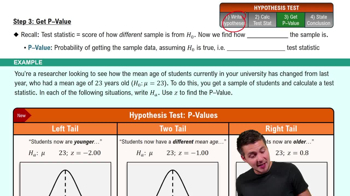
Step 1: Write Hypotheses
P-value
The P-value is a measure that helps determine the strength of the evidence against the null hypothesis. It represents the probability of obtaining a test statistic as extreme as, or more extreme than, the one observed, assuming the null hypothesis is true. A smaller P-value indicates stronger evidence against the null hypothesis. In this scenario, if the P-value is less than the significance level of 0.05, it would lead to rejecting the null hypothesis in favor of the alternative.
Recommended video:
Guided course
Step 3: Get P-Value
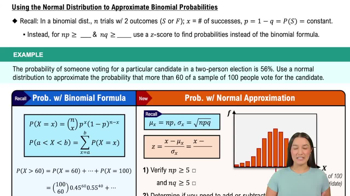
Normal Approximation to the Binomial Distribution
The normal approximation to the binomial distribution is a technique used when dealing with large sample sizes, allowing the binomial distribution to be approximated by a normal distribution. This is applicable when both np and n(1-p) are greater than 5, where n is the sample size and p is the probability of success. In this case, the sample of 5005 adults can be analyzed using the normal distribution to simplify calculations related to proportions, such as determining the test statistic and P-value.
Recommended video:
Using the Normal Distribution to Approximate Binomial Probabilities
Watch next
Master Performing Hypothesis Tests: Proportions with a bite sized video explanation from Patrick
Start learningRelated Videos
Related Practice
Textbook Question
34
views