Notation Common tests such as the SAT, ACT, LSAT, and MCAT tests use multiple choice test questions, each with possible answers of a, b, c, d, e, and each question has only one correct answer. For people who make random guesses for answers to a block of 100 questions, identify the values of p, q, μ, and σ. What do μ and σ measure?
Table of contents
- 1. Intro to Stats and Collecting Data1h 14m
- 2. Describing Data with Tables and Graphs1h 56m
- 3. Describing Data Numerically2h 5m
- 4. Probability2h 17m
- 5. Binomial Distribution & Discrete Random Variables3h 6m
- 6. Normal Distribution and Continuous Random Variables2h 11m
- 7. Sampling Distributions & Confidence Intervals: Mean3h 23m
- Sampling Distribution of the Sample Mean and Central Limit Theorem19m
- Distribution of Sample Mean - ExcelBonus23m
- Introduction to Confidence Intervals15m
- Confidence Intervals for Population Mean1h 18m
- Determining the Minimum Sample Size Required12m
- Finding Probabilities and T Critical Values - ExcelBonus28m
- Confidence Intervals for Population Means - ExcelBonus25m
- 8. Sampling Distributions & Confidence Intervals: Proportion2h 10m
- 9. Hypothesis Testing for One Sample5h 8m
- Steps in Hypothesis Testing1h 6m
- Performing Hypothesis Tests: Means1h 4m
- Hypothesis Testing: Means - ExcelBonus42m
- Performing Hypothesis Tests: Proportions37m
- Hypothesis Testing: Proportions - ExcelBonus27m
- Performing Hypothesis Tests: Variance12m
- Critical Values and Rejection Regions28m
- Link Between Confidence Intervals and Hypothesis Testing12m
- Type I & Type II Errors16m
- 10. Hypothesis Testing for Two Samples5h 37m
- Two Proportions1h 13m
- Two Proportions Hypothesis Test - ExcelBonus28m
- Two Means - Unknown, Unequal Variance1h 3m
- Two Means - Unknown Variances Hypothesis Test - ExcelBonus12m
- Two Means - Unknown, Equal Variance15m
- Two Means - Unknown, Equal Variances Hypothesis Test - ExcelBonus9m
- Two Means - Known Variance12m
- Two Means - Sigma Known Hypothesis Test - ExcelBonus21m
- Two Means - Matched Pairs (Dependent Samples)42m
- Matched Pairs Hypothesis Test - ExcelBonus12m
- Two Variances and F Distribution29m
- Two Variances - Graphing CalculatorBonus16m
- 11. Correlation1h 24m
- 12. Regression3h 33m
- Linear Regression & Least Squares Method26m
- Residuals12m
- Coefficient of Determination12m
- Regression Line Equation and Coefficient of Determination - ExcelBonus8m
- Finding Residuals and Creating Residual Plots - ExcelBonus11m
- Inferences for Slope31m
- Enabling Data Analysis ToolpakBonus1m
- Regression Readout of the Data Analysis Toolpak - ExcelBonus21m
- Prediction Intervals13m
- Prediction Intervals - ExcelBonus19m
- Multiple Regression - ExcelBonus29m
- Quadratic Regression15m
- Quadratic Regression - ExcelBonus10m
- 13. Chi-Square Tests & Goodness of Fit2h 21m
- 14. ANOVA2h 29m
6. Normal Distribution and Continuous Random Variables
Standard Normal Distribution
Problem 6.6.1a
Textbook Question
Continuity Correction In testing the assumption that the probability of a baby boy is 0.512, a geneticist obtains a random sample of 1000 births and finds that 502 of them are boys. Using the continuity correction, describe the area under the graph of a normal distribution corresponding to the following. (For example, the area corresponding to “the probability of at least 502 boys” is this: the area to the right of 501.5.)
a. The probability of 502 or fewer boys
Verified step by step guidance1
Step 1: Understand the problem. We are tasked with finding the probability of 502 or fewer boys in a sample of 1000 births, assuming the probability of a boy is 0.512. This involves using the normal approximation to the binomial distribution with a continuity correction.
Step 2: Calculate the mean (μ) and standard deviation (σ) of the binomial distribution. The mean is given by μ = n * p, where n is the sample size (1000) and p is the probability of a boy (0.512). The standard deviation is given by σ = sqrt(n * p * (1 - p)).
Step 3: Apply the continuity correction. Since we are looking for the probability of 502 or fewer boys, we adjust the value to 502.5 to account for the discrete-to-continuous transition.
Step 4: Standardize the value using the z-score formula. The z-score is calculated as z = (X - μ) / σ, where X is the adjusted value (502.5), μ is the mean, and σ is the standard deviation.
Step 5: Use the standard normal distribution table or a statistical software to find the cumulative probability corresponding to the calculated z-score. This cumulative probability represents the area under the normal curve to the left of 502.5, which is the probability of 502 or fewer boys.
Verified video answer for a similar problem:This video solution was recommended by our tutors as helpful for the problem above
Video duration:
1mPlay a video:
0 Comments
Key Concepts
Here are the essential concepts you must grasp in order to answer the question correctly.
Normal Distribution
The normal distribution is a continuous probability distribution characterized by its bell-shaped curve, defined by its mean and standard deviation. It is widely used in statistics because many real-world phenomena tend to follow this distribution. In hypothesis testing, the normal distribution helps to approximate the behavior of sample proportions, especially with large sample sizes, allowing for easier calculation of probabilities.
Recommended video:
Guided course
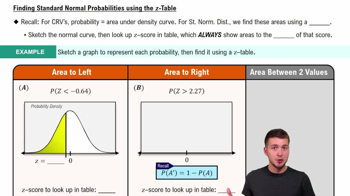
Finding Standard Normal Probabilities using z-Table
Continuity Correction
Continuity correction is a technique used when a discrete distribution is approximated by a continuous distribution, such as the normal distribution. It involves adjusting the discrete values by 0.5 to account for the fact that continuous distributions can take on any value within a range, while discrete distributions can only take specific values. This correction improves the accuracy of probability estimates, particularly in cases involving binomial distributions.
Recommended video:
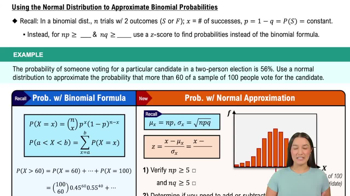
Using the Normal Distribution to Approximate Binomial Probabilities
Cumulative Probability
Cumulative probability refers to the probability that a random variable takes on a value less than or equal to a specific value. In the context of the normal distribution, it is represented by the area under the curve to the left of a given point. For example, to find the probability of 502 or fewer boys, one would calculate the cumulative probability up to 501.5, which incorporates the continuity correction for more accurate results.
Recommended video:
Introduction to Probability
Related Videos
Related Practice
Textbook Question
122
views