The data in the next column shows birth rate and per capita income (in thousands of 2012 dollars) from 2005 through 2017. Draw a time-series plot for both birth rate and per capita income. Comment on any trends.
Table of contents
- 1. Intro to Stats and Collecting Data1h 14m
- 2. Describing Data with Tables and Graphs1h 56m
- 3. Describing Data Numerically2h 5m
- 4. Probability2h 17m
- 5. Binomial Distribution & Discrete Random Variables3h 6m
- 6. Normal Distribution and Continuous Random Variables2h 11m
- 7. Sampling Distributions & Confidence Intervals: Mean3h 23m
- Sampling Distribution of the Sample Mean and Central Limit Theorem19m
- Distribution of Sample Mean - ExcelBonus23m
- Introduction to Confidence Intervals15m
- Confidence Intervals for Population Mean1h 18m
- Determining the Minimum Sample Size Required12m
- Finding Probabilities and T Critical Values - ExcelBonus28m
- Confidence Intervals for Population Means - ExcelBonus25m
- 8. Sampling Distributions & Confidence Intervals: Proportion2h 10m
- 9. Hypothesis Testing for One Sample5h 8m
- Steps in Hypothesis Testing1h 6m
- Performing Hypothesis Tests: Means1h 4m
- Hypothesis Testing: Means - ExcelBonus42m
- Performing Hypothesis Tests: Proportions37m
- Hypothesis Testing: Proportions - ExcelBonus27m
- Performing Hypothesis Tests: Variance12m
- Critical Values and Rejection Regions28m
- Link Between Confidence Intervals and Hypothesis Testing12m
- Type I & Type II Errors16m
- 10. Hypothesis Testing for Two Samples5h 37m
- Two Proportions1h 13m
- Two Proportions Hypothesis Test - ExcelBonus28m
- Two Means - Unknown, Unequal Variance1h 3m
- Two Means - Unknown Variances Hypothesis Test - ExcelBonus12m
- Two Means - Unknown, Equal Variance15m
- Two Means - Unknown, Equal Variances Hypothesis Test - ExcelBonus9m
- Two Means - Known Variance12m
- Two Means - Sigma Known Hypothesis Test - ExcelBonus21m
- Two Means - Matched Pairs (Dependent Samples)42m
- Matched Pairs Hypothesis Test - ExcelBonus12m
- Two Variances and F Distribution29m
- Two Variances - Graphing CalculatorBonus16m
- 11. Correlation1h 24m
- 12. Regression3h 33m
- Linear Regression & Least Squares Method26m
- Residuals12m
- Coefficient of Determination12m
- Regression Line Equation and Coefficient of Determination - ExcelBonus8m
- Finding Residuals and Creating Residual Plots - ExcelBonus11m
- Inferences for Slope31m
- Enabling Data Analysis ToolpakBonus1m
- Regression Readout of the Data Analysis Toolpak - ExcelBonus21m
- Prediction Intervals13m
- Prediction Intervals - ExcelBonus19m
- Multiple Regression - ExcelBonus29m
- Quadratic Regression15m
- Quadratic Regression - ExcelBonus10m
- 13. Chi-Square Tests & Goodness of Fit2h 21m
- 14. ANOVA2h 29m
2. Describing Data with Tables and Graphs
Visualizing Qualitative vs. Quantitative Data
Problem 2.3.8b
Textbook Question
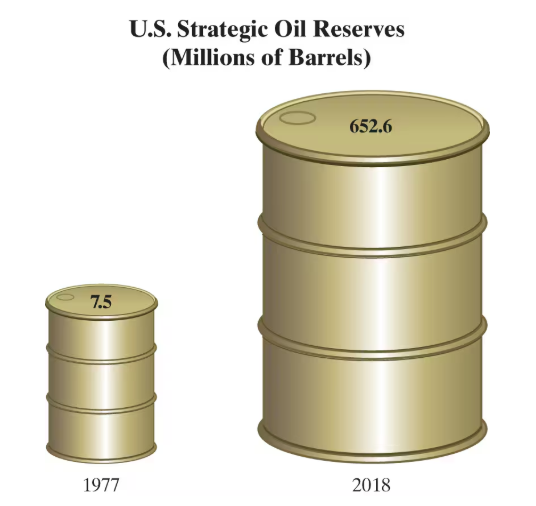
The U.S. Strategic Oil Reserve is a government-owned stockpile of crude oil. It was established after the oil embargo in the mid-1970s and is meant to serve as a national defense fuel reserve, as well as to offset reductions in commercial oil supplies that would threaten the U.S. economy. The graphic depicts oil reserves in 1977 and 2018.
b. The United States imported approximately 10.14 million barrels of oil per day in 2018. At that rate, assuming no change in U.S. oil production, how long would the U.S. strategic oil reserve last if no oil were imported?

Verified step by step guidance1
Identify the total amount of oil in the U.S. Strategic Oil Reserve in 2018 from the image, which is 652.6 million barrels.
Note the daily oil import rate for the U.S. in 2018, given as 10.14 million barrels per day.
Understand that the question asks how long the reserve would last if no oil were imported, assuming daily consumption remains the same as the import rate.
Set up the calculation to find the number of days the reserve would last by dividing the total reserve by the daily consumption rate: \(\text{Number of days} = \frac{652.6 \text{ million barrels}}{10.14 \text{ million barrels/day}}\).
Interpret the result as the duration (in days) the U.S. Strategic Oil Reserve can supply oil without any imports, assuming constant daily usage.
Verified video answer for a similar problem:This video solution was recommended by our tutors as helpful for the problem above
Video duration:
3mPlay a video:
0 Comments
Key Concepts
Here are the essential concepts you must grasp in order to answer the question correctly.
Unit Conversion and Scale
Understanding units and scale is essential for interpreting the data correctly. The oil reserves are given in millions of barrels, while daily imports are in millions of barrels per day. Converting these units appropriately allows for accurate calculations of how long the reserves will last.
Recommended video:
Uniform Distribution Example 1
Rate and Time Relationship
This concept involves using the formula time = quantity ÷ rate. Here, the total oil reserve (quantity) is divided by the daily import rate to find how many days the reserve can supply oil if imports stop. This relationship is fundamental in solving problems involving consumption over time.
Recommended video:
Creating Time-Series Graphs
Interpretation of Graphical Data
The image visually compares oil reserves from 1977 and 2018, highlighting the increase in reserves. Interpreting such graphics helps in understanding the magnitude of data and provides context for numerical calculations, ensuring the problem is grounded in real-world data.
Recommended video:
Introduction to Collecting Data
Related Videos
Related Practice
Textbook Question
28
views