SAT Total Scores Use the normal distribution in Exercise 13. b. Out of 1000 randomly selected SAT total scores, about how many would you expect to be greater than 1100?
Verified step by step guidance
1
Identify the key components of the problem: The SAT total scores are normally distributed, and we are tasked with finding the number of scores greater than 1100 out of 1000 randomly selected scores. This requires calculating the probability of a score being greater than 1100 and then scaling it to the sample size of 1000.
Standardize the score of 1100 using the z-score formula: , where is the score (1100), is the mean of the distribution, and is the standard deviation. These values should be provided in the problem or assumed based on typical SAT score distributions (e.g., and ).
Use the z-score to find the cumulative probability from the standard normal distribution table or a statistical software. This gives the probability of a score being less than 1100. Subtract this value from 1 to find the probability of a score being greater than 1100: .
Multiply the probability of a score being greater than 1100 by the total number of scores (1000) to find the expected number of scores greater than 1100: .
Interpret the result: The final value represents the expected number of SAT scores greater than 1100 out of the 1000 randomly selected scores.
Verified video answer for a similar problem:
This video solution was recommended by our tutors as helpful for the problem above
Video duration:
2m
Play a video:
0 Comments
Key Concepts
Here are the essential concepts you must grasp in order to answer the question correctly.
Normal Distribution
The normal distribution is a probability distribution that is symmetric about the mean, depicting that data near the mean are more frequent in occurrence than data far from the mean. It is characterized by its bell-shaped curve and is defined by two parameters: the mean (average) and the standard deviation (which measures the spread of the data). Understanding this distribution is crucial for making inferences about populations based on sample data.
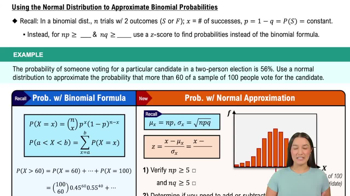
Using the Normal Distribution to Approximate Binomial Probabilities
Z-scores
A Z-score indicates how many standard deviations an element is from the mean of a distribution. It is calculated by subtracting the mean from the value and then dividing by the standard deviation. Z-scores are essential for determining the probability of a score occurring within a normal distribution, allowing us to find the proportion of scores that fall above or below a certain value, such as 1100 in this case.
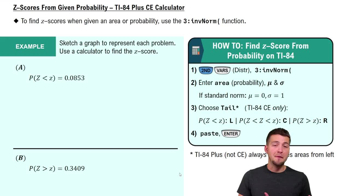
Z-Scores From Given Probability - TI-84 (CE) Calculator
Empirical Rule
The empirical rule, also known as the 68-95-99.7 rule, states that for a normal distribution, approximately 68% of the data falls within one standard deviation of the mean, 95% within two standard deviations, and 99.7% within three standard deviations. This rule helps in estimating the likelihood of scores exceeding a certain threshold, such as 1100, by providing a quick way to assess how many scores lie beyond a specified number of standard deviations from the mean.