In Exercises 7 and 8, find the margin of error for the values of c, s, and n. c = 0.95, s = 5, n = 16
Verified step by step guidance
1
Step 1: Understand the formula for the margin of error (ME). The formula is ME = z * (s / sqrt(n)), where z is the critical value corresponding to the confidence level (c), s is the sample standard deviation, and n is the sample size.
Step 2: Determine the critical value (z) for the given confidence level (c = 0.95). For a 95% confidence level, the z-value can be found using a z-table or statistical software. It corresponds to the area under the standard normal curve.
Step 3: Calculate the standard error (SE) of the sample mean using the formula SE = s / sqrt(n). Substitute the given values of s = 5 and n = 16 into the formula.
Step 4: Multiply the critical value (z) by the standard error (SE) to compute the margin of error (ME). This step combines the results from Step 2 and Step 3.
Step 5: Interpret the margin of error in the context of the problem. It represents the range within which the true population mean is expected to lie with 95% confidence.
Verified video answer for a similar problem:
This video solution was recommended by our tutors as helpful for the problem above
Video duration:
2m
Play a video:
0 Comments
Key Concepts
Here are the essential concepts you must grasp in order to answer the question correctly.
Margin of Error
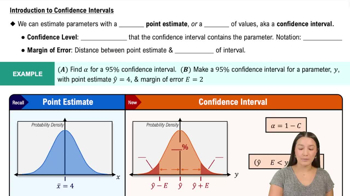
The margin of error quantifies the uncertainty in a statistical estimate. It indicates the range within which the true population parameter is expected to lie, given a certain confidence level. A smaller margin of error suggests a more precise estimate, while a larger margin indicates more variability. It is commonly calculated using the formula: Margin of Error = z * (s / √n), where z is the z-score corresponding to the desired confidence level.
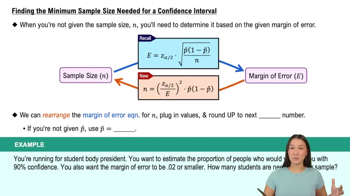
Finding the Minimum Sample Size Needed for a Confidence Interval
Confidence Level
The confidence level represents the probability that the margin of error will contain the true population parameter. It is expressed as a percentage, with common levels being 90%, 95%, and 99%. A higher confidence level means a wider margin of error, reflecting greater uncertainty about the estimate. In this case, c = 0.95 indicates a 95% confidence level, meaning we can be 95% confident that the true value lies within the calculated margin of error.
Sample size (n) refers to the number of observations or data points collected in a study. It plays a crucial role in determining the reliability and validity of statistical estimates. A larger sample size generally leads to a smaller margin of error, enhancing the precision of the estimate. In this question, n = 16 indicates that the analysis is based on 16 observations, which will influence the calculation of the margin of error.