Which types of probability calculations require the use of the addition rule, and how is the rule applied for mutually exclusive and non-mutually exclusive events?
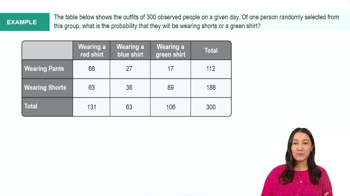
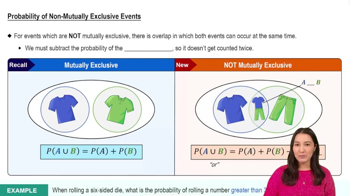
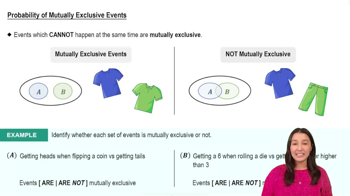
The addition rule is used when calculating the probability of the union of two events, that is, the probability that event A or event B occurs (P(A or B)). For mutually exclusive events (which cannot occur at the same time), the rule is: P(A or B) = P(A) + P(B). For non-mutually exclusive events (which can occur together), the rule is: P(A or B) = P(A) + P(B) - P(A and B), where P(A and B) is subtracted to avoid double-counting the overlap.
 Back
Back
 5:14
5:14