Back

Introduction to Confidence Intervals definitions

Control buttons has been changed to "navigation" mode.
1/15
  • Confidence Interval

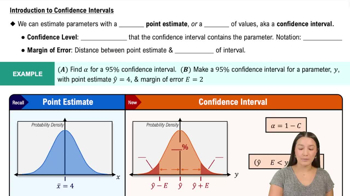
    A range constructed around a point estimate, indicating where a parameter is likely to fall with a specified probability.
  • Parameter

    A value representing a characteristic of a population, often estimated using sample data.
  • Point Estimate

    A single value derived from sample data, used as the best guess for an unknown population parameter.
  • Margin of Error

    The maximum likely difference between a point estimate and the true parameter, defining the interval's width.
  • Confidence Level

    The probability that a constructed interval contains the true parameter, commonly expressed as a percentage.
  • Alpha

    The probability that the true parameter lies outside the confidence interval, calculated as 1 minus the confidence level.
  • Critical Value

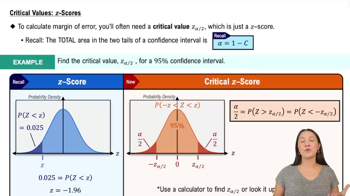
    A threshold, often a z-score, marking the endpoints of a confidence interval based on the chosen confidence level.
  • Z-Score

    A standardized value indicating how many standard deviations a point is from the mean, used in interval calculations.
  • Standard Normal Distribution

    A symmetric, bell-shaped curve with mean zero and standard deviation one, underlying z-score calculations.
  • Endpoint

    A value marking the boundary of a confidence interval, calculated by adding or subtracting margin of error from the point estimate.
  • Tail Area

    The region under the curve outside the confidence interval, representing the probability of not containing the parameter.
  • Interval Notation

    A format expressing a confidence interval as two values in parentheses, denoting its lower and upper bounds.
  • Z Table

    A reference chart listing areas under the standard normal curve for various z-scores, used to find critical values.
  • Complement

    The portion of probability not included in the confidence level, represented by alpha in interval calculations.
  • Probability

    A measure quantifying the likelihood of an event, such as a parameter falling within a confidence interval.