In the context of contingency tables, what does 'marginal' mean?
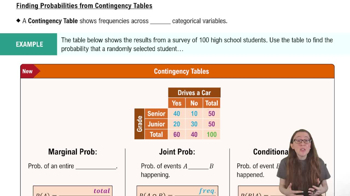
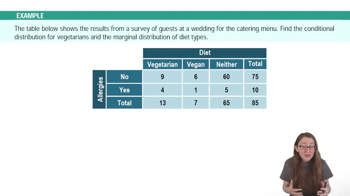
In contingency tables, 'marginal' refers to the probability or total associated with a single category of one variable, regardless of the other variable. Marginal probabilities are calculated using the row or column totals (margins) divided by the grand total.
What does each cell in a contingency table represent?
Each cell shows the frequency of responses that fall into the intersection of two categories, one from each variable. For example, it might show the number of juniors who do not drive a car.
How do you identify the grand total in a contingency table?
The grand total is found at the intersection of the total row and total column. It represents the sum of all responses in the survey.
What is the numerator when calculating the joint probability from a contingency table?
The numerator is the cell frequency at the intersection of the two categories of interest. This value represents the number of cases where both events occur.
How can you recognize a joint probability question in word problems?
Joint probability questions often use the word 'and' to ask about the probability of two events happening together. They require finding the intersection of two categories in the table.
What phrase in a probability question indicates you should use conditional probability?
Phrases like 'given,' 'assuming,' or 'if we know' signal that conditional probability is needed. These indicate that one event has already occurred.
When calculating conditional probability, what is used as the denominator?
The denominator is the total for the given condition, which is either a row or column total. It restricts the sample space to only those cases where the condition is met.
How do you find the probability that a student is a junior who does not drive a car?
Locate the cell for juniors who do not drive a car and divide its frequency by the grand total. This gives the joint probability for those two categories.
What is the difference between joint and conditional probability in contingency tables?
Joint probability considers the chance of two events happening together, using the cell frequency over the grand total. Conditional probability focuses on one event given another, using the cell frequency over the relevant row or column total.
Why are row and column totals important in contingency tables?
Row and column totals provide the category totals needed for calculating marginal and conditional probabilities. They help summarize the data for each variable separately.