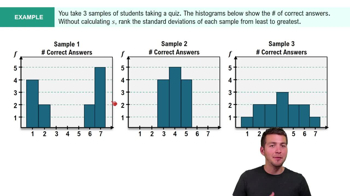
What does a flatter distribution curve indicate about the standard deviation?
A flatter distribution curve indicates a higher standard deviation, meaning the data values are more spread out around the mean.
What does the letter 's' represent in the context of standard deviation?
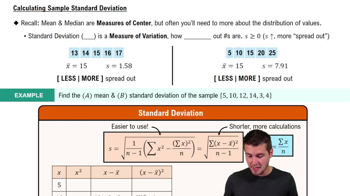
The letter 's' represents the standard deviation of a sample. It quantifies how spread out the data values are around the mean.
How does the standard deviation change when data values are more bunched up around the mean?
When data values are more bunched up around the mean, the standard deviation is lower. This indicates less variability in the dataset.
What is the first step in calculating the mean of a sample data set?
The first step is to add up all the data values in the sample. Then, divide the sum by the total number of observations.
In the standard deviation formula, what does the term Σx² refer to?
Σx² refers to the sum of the squares of each individual data value. It is calculated by squaring each value and then adding them together.
Why do you subtract (Σx)²/n from Σx² in the standard deviation calculation?
Subtracting (Σx)²/n from Σx² removes the effect of the mean from the sum of squares. This isolates the variability of the data around the mean.
What is the purpose of dividing by n-1 in the sample standard deviation formula?
Dividing by n-1 corrects for bias in estimating population variability from a sample. It is known as Bessel's correction.
How do you use the alternative standard deviation formula involving (x - x̄)²?
You subtract the mean from each data value, square the result, and then sum these squared differences. Finally, divide by n-1 and take the square root.
What symbols are commonly used for population standard deviation and mean?
Population standard deviation is often denoted by the Greek letter sigma (σ), and the population mean by mu (μ). These differ from sample statistics symbols.
What should you do if your professor prefers a specific standard deviation formula?
You should use the formula preferred by your professor or course guidelines. Both formulas yield the same result if applied correctly.
 Back
Back
 08:45
08:45