Back

Standard Normal Distribution definitions

Control buttons has been changed to "navigation" mode.
1/15
  • Variance

    Represents the average squared difference between outcomes and the mean in a probability distribution.
  • Standard Deviation

    Measures the spread of outcomes in a distribution; calculated as the square root of variance.
  • Discrete Random Variable

    A variable with distinct, countable outcomes, each associated with a probability.
  • Probability Distribution

    A table or function showing possible values of a random variable and their associated probabilities.
  • Expected Value

    The mean of a probability distribution, found by summing each outcome times its probability.
  • Z Score

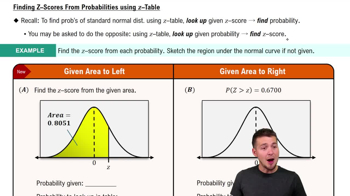
    Indicates how many standard deviations an element is from the mean in a normal distribution.
  • Z Table

    A reference chart listing cumulative probabilities for z scores in the standard normal distribution.
  • Standard Normal Curve

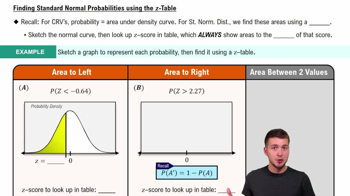
    A symmetric, bell-shaped graph representing a normal distribution with mean zero and standard deviation one.
  • Cumulative Probability

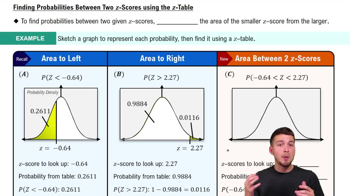
    The total probability from the left up to a specific value under the standard normal curve.
  • Complement

    The probability of the opposite event, calculated as one minus the given probability.
  • Area to the Left

    The region under the standard normal curve from the far left up to a specified z score.
  • Area to the Right

    The region under the standard normal curve from a specified z score to the far right.
  • Mean Squared

    The square of the mean value in a probability distribution, used in variance calculations.
  • Probability

    A value between zero and one representing the likelihood of a specific outcome in a distribution.
  • Spread

    Describes how much the values in a distribution differ from the mean, often quantified by variance or standard deviation.