What is the F distribution used for in statistics?
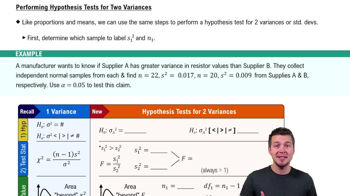
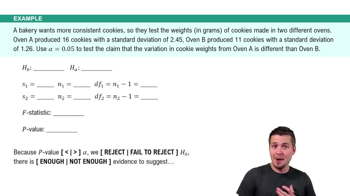
The F distribution is used for two-sample hypothesis tests for variance, comparing the variances of two populations.
How is the F statistic calculated in a two-sample variance test?
The F statistic is calculated as the ratio of the two sample variances, with the larger variance as the numerator: s1^2 / s2^2.
What are the degrees of freedom for the numerator and denominator in the F distribution?
The numerator's degrees of freedom is n1 - 1, and the denominator's is n2 - 1, where n1 and n2 are the sample sizes.
Why must the larger sample variance be placed in the numerator when calculating the F statistic?
The larger sample variance is placed in the numerator to ensure the F statistic is greater than or equal to 1, which simplifies interpretation and table lookup.
What is the null hypothesis in a two-sample test for variance?
The null hypothesis is that the two population variances are equal: σ1^2 = σ2^2.
What is the alternative hypothesis if you want to test if one variance is greater than the other?
The alternative hypothesis is that one population variance is greater than the other, for example, σ1^2 > σ2^2.
What distribution is used for a one-sample variance test?
A one-sample variance test uses the chi-squared distribution.
What are the assumptions for using the F test for two variances?
The samples must be independent, random, and drawn from normally distributed populations.
How do you find the p-value for an F statistic using a calculator?
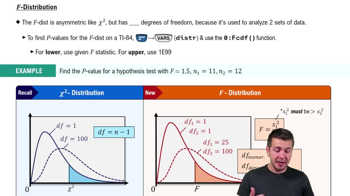
You use the Fcdf function, inputting the F statistic as the lower bound, a large number as the upper bound, and the two degrees of freedom.
What does a p-value greater than the significance level α indicate in an F test?
It indicates that you fail to reject the null hypothesis, meaning there is not enough evidence to say the variances are different.
What is the shape of the F distribution?
The F distribution is asymmetric and right-skewed, starting at zero and extending to positive infinity.
When setting up a two-sample variance test, what is the first step before stating hypotheses?
The first step is to identify which sample variance is larger and assign it as s1^2 for the numerator.
What is the critical value approach in the F test?
The critical value approach involves comparing the calculated F statistic to a value from the F distribution table based on α and the degrees of freedom.
How does the F distribution compare to the chi-squared distribution?
Both are right-skewed and positive, but the F distribution has two degrees of freedom because it compares two samples.
What does it mean if the calculated F statistic is close to 1?
It suggests that the sample variances are similar, providing little evidence against the null hypothesis of equal variances.
 Back
Back
 04:20
04:20