 Back
BackDiscrete Probability Distributions and Binomial Distribution
 04:14
04:14
Terms in this set (20)
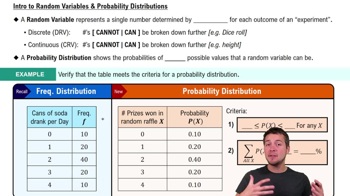
A random variable is a quantitative variable whose values are determined by chance, linking the sample space to numerical values.
Discrete random variables take finite or countable values (usually integers). Continuous random variables have infinitely many values.
A probability distribution describes the probability for each value of a random variable, often shown as a table, formula, or graph.
A p.m.f. is a function that gives the probability associated with each value of a discrete random variable.
- Random variable x with associated probabilities.
- Each probability satisfies 0 ≤ P(x) ≤ 1.
- The sum of all probabilities equals 1.
Sum the probabilities for all values of X greater than or equal to 2: \(P(X \geq 2) = P(X=2) + P(X=3) + \cdots\).
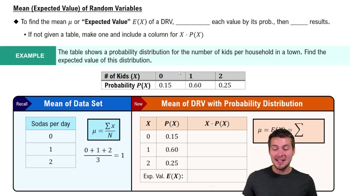
The expected value is the mean of the outcomes: \(\mu = E[X] = \sum x \cdot P(x)\).
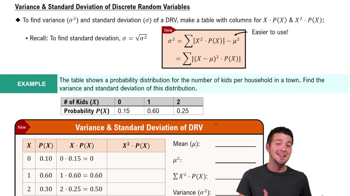
Variance: \(\sigma^2 = E[X^2] - (E[X])^2\). Standard deviation: \(\sigma = \sqrt{\sigma^2}\).
- Two possible outcomes: success or failure.
- Trials are independent.
- Constant probability of success p.
A binomial random variable counts the number of successes in n independent Bernoulli trials with success probability p.
\(P(x) = \binom{n}{x} p^x (1-p)^{n-x}\), where \(\binom{n}{x} = \frac{n!}{x!(n-x)!}\).
Mean: \(\mu = np\). Standard deviation: \(\sigma = \sqrt{np(1-p)}\).
Use probabilities: significantly high if \(P(X \geq x) \leq 0.05\), significantly low if \(P(X \leq x) \leq 0.05\).
Significant values lie outside \([\mu - 2\sigma, \mu + 2\sigma]\).
Using binomial distribution: \(P(X=3) = 0.2568\).
\(P(X \leq 2) = 0.2201\) by summing probabilities for X=0,1,2.
\(P(X < 2) = P(X=0) + P(X=1) = 0.0632\).
- Open StatCrunch, select Stat > Calculators > Binomial.
- Enter n, p, and inequality.
- Click Compute to get probability.
A probability histogram shows probabilities on the vertical axis instead of relative frequencies.
A valid distribution has probabilities between 0 and 1 and sums to 1; invalid distributions violate these rules.