Back

M181A Ch 1 and 2

Control buttons has been changed to "navigation" mode.
1/21
  • Joint probability mass function (pmf) of discrete random variables

    The joint pmf of discrete random variables X and Y gives the probability that X = x and Y = y simultaneously.
  • Marginal pmf from joint pmf

    The marginal pmf of X is obtained by summing the joint pmf over all values of Y: P_X(x) = Σ_y P_{X,Y}(x,y).
  • Joint density function of continuous random variables

    For continuous X and Y, the joint density function f_{X,Y}(x,y) satisfies P((X,Y) in A) = ∫∫_A f_{X,Y}(x,y) dx dy for any region A.
  • Marginal density from joint density

    The marginal density of X is f_X(x) = ∫ f_{X,Y}(x,y) dy, integrating the joint density over all y.
  • Independence of two discrete random variables

    X and Y are independent if for all x,y, P_{X,Y}(x,y) = P_X(x) P_Y(y).
  • Independence of two continuous random variables

    X and Y are independent if for all x,y, f_{X,Y}(x,y) = f_X(x) f_Y(y).
  • Linearity of expectation

    For any random variables X, Y and constants a, b: E[aX + bY] = a E[X] + b E[Y].
  • Expectation of product of independent variables

    If X and Y are independent, then E[XY] = E[X] E[Y]. More generally, E[g(X) h(Y)] = E[g(X)] E[h(Y)].
  • Variance of linear combination of independent variables

    If X and Y are independent, \(Var(aX + bY) = a^2 Var(X) + b^2 Var(Y).\)

  • Covariance of two random variables

    \(Cov(X,Y) = E[(X - E[X])(Y - E[Y])] \)measures linear dependence between X and Y.

  • Correlation coefficient

    Correlation ρ = Cov(X,Y) / (SD(X) SD(Y)) measures strength and direction of linear relationship between X and Y.
  • Cauchy–Schwarz inequality in probability

    For any X, Y, |Cov(X,Y)| ≤ SD(X) SD(Y), ensuring correlation is between -1 and 1.
  • Markov's Inequality

    For nonnegative random variable X and a > 0, P(X ≥ a) ≤ E[X] / a.
  • Chebyshev's Inequality

    For random variable X with mean μ and variance σ^2, P(|X - μ| ≥ a) ≤ σ^2 / a^2.
  • Definition of i.i.d. random variables

    Random variables X_1, ..., X_n are independent and identically distributed (i.i.d.) if each has the same distribution and are mutually independent.
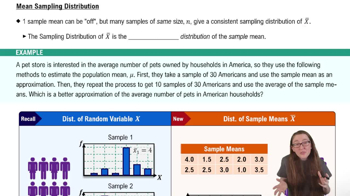
  • Sample mean and sample sum

    Sample sum S_n = Σ_{i=1}^n X_i; sample mean Ȳ_n = S_n / n.
  • Weak Law of Large Numbers (WLLN)

    For i.i.d. \(X_i \)with mean \(μ\), for any \(ε > 0, P(|Ȳ_n - μ| > ε) → 0\) as \(n → ∞\).

  • Strong Law of Large Numbers (SLLN)

    For i.i.d. \(X_i \)with mean \(μ, Ȳ_n \)converges almost surely to \(μ \)as \(n → ∞\).

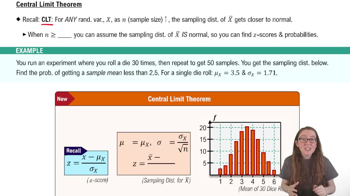
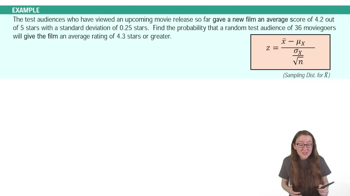
  • Central Limit Theorem (CLT)

    For i.i.d. \(X_i \)with mean μ and variance\( σ^2, (S_n - nμ) / (σ√n) \)converges in distribution to standard normal.

  • Normal approximation to the Binomial distribution

    For \(X ~ Binomial(n,p), X ≈ Normal(np, np(1-p)) \)for large \(n\), using CLT.

  • Continuity correction in normal approximation

    Adjust binomial normal approximation by ±0.5 to improve accuracy when approximating discrete with continuous.