A density curve is a smooth curve that represents the distribution of a continuous variable, where the total area under the curve equals one.
What are the conditions for a continuous probability distribution?
1. The random variable is continuous. 2. The probability density function (p.d.f.) 𝑓(𝑥) ≥ 0 for all x. 3. The total area under the p.d.f. curve is one.
Define a uniform distribution.
A uniform distribution is a continuous distribution where values are evenly spread over an interval [a, b], with p.d.f. 𝑓(𝑥) = 1/(b−a) for 𝑎 ≤ 𝑥 ≤ 𝑏, and zero otherwise.
How do you find the height of a uniform distribution's density curve?
The height is \(\frac{1}{b-a}\), ensuring the total area (height × width) equals 1.
What characterizes a normal distribution?
A normal distribution is bell-shaped, symmetric about the mean 𝜇, and determined by mean 𝜇 and standard deviation 𝜎.
What is the formula for the normal distribution's probability density function?
The p.d.f. is \(y=\frac{1}{\sigma\sqrt{2\pi}} e^{-\frac{1}{2}\left(\frac{x-\mu}{\sigma}\right)^2}\).
What is the standard normal distribution?
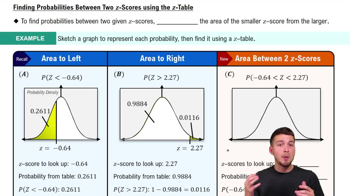
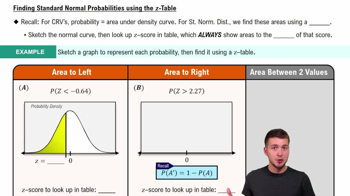
A standard normal distribution has mean 0 and standard deviation 1, with its curve called the standard normal curve.
How do you standardize a normal variable to find its z-score?
Use \(z=\frac{x-\mu}{\sigma}\) to convert x to a z-score in the standard normal distribution.
How to find the probability for a normal variable using StatCrunch?
Use StatCrunch's Normal calculator, input mean and standard deviation, select inequality type, enter z or x value, and compute.
What is a critical value 𝑧𝛼 in the standard normal distribution?
𝑧𝛼 is the z-score where the area to the right under the standard normal curve equals 𝛼.
What is the sampling distribution of the sample mean?
It is the distribution of sample means from all possible samples of the same size from a population.
What is the mean of the sampling distribution of the sample mean?
The mean of the sample means equals the population mean, \(\mu_{\bar{x}}=\mu\).
What is the standard deviation of the sampling distribution of the sample mean?
The standard deviation is \(\sigma_{\bar{x}}=\frac{\sigma}{\sqrt{n}}\), where n is the sample size.
What is the sampling distribution of a sample proportion?
It is approximately normal with mean equal to the population proportion p and standard deviation \(\sqrt{\frac{p(1-p)}{n}}\), given np≥5 and n(1-p)≥5.
State the Central Limit Theorem (CLT).
For large sample sizes (n≥30), the sampling distribution of the sample mean is approximately normal with mean 𝜇 and standard deviation \(\frac{\sigma}{\sqrt{n}}\), regardless of the population distribution.
How to use the CLT when the population is normal?
The sample mean 𝑥̅ is normally distributed with mean 𝜇 and standard deviation \(\frac{\sigma}{\sqrt{n}}\) for any sample size.
What if the population is not normal and n < 30?
The sampling distribution of 𝑥̅ may not be normal; use nonparametric or bootstrapping methods instead.
How to find a z-score given a percentile?
Use the inverse normal function or StatCrunch to find z such that the area to the left equals the percentile.
How to find an x value given a probability in a normal distribution?
Use the z-score corresponding to the probability and convert back: \(x=\mu + z\sigma\).
What is sampling error?
Sampling error is the difference between a sample statistic and the true population parameter due to random sampling variability.
 Back
Back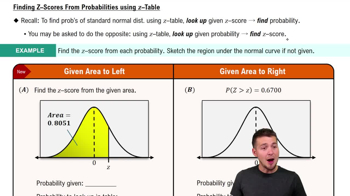
 08:50
08:50