Ch. 1 - Introduction to Statistics
Larson - Elementary Statistics: Picturing the World 8th Edition
Larson8th EditionElementary Statistics: Picturing the WorldISBN: 9780137493470Not the one you use?Change textbook
Chapter 1, Problem 1.1.38

Determine whether the number describes a population parameter or a sample statistic. Explain your reasoning.
In January 2021, 54% of the governors of the 50 states in the United States were Republicans. (Source: National Governors Association)

Verified step by step guidance
1
Identify the key terms in the problem: 'population parameter' refers to a numerical value that describes a characteristic of an entire population, while 'sample statistic' refers to a numerical value that describes a characteristic of a subset (sample) of the population.
Examine the context of the problem: The problem states that the percentage (54%) is based on all 50 governors of the United States. This indicates that the data includes the entire population of governors, not just a subset.
Determine whether the number represents a population parameter or a sample statistic: Since the data includes all 50 governors, the percentage (54%) describes a characteristic of the entire population of governors.
Explain the reasoning: A population parameter is used when the data represents the entire population. In this case, the 54% is a population parameter because it is based on all governors, not a sample.
Conclude: The number 54% describes a population parameter because it summarizes a characteristic of the entire population of U.S. state governors in January 2021.

Verified video answer for a similar problem:

This video solution was recommended by our tutors as helpful for the problem above.
Video duration:
4m
Was this helpful?

Key Concepts

Here are the essential concepts you must grasp in order to answer the question correctly.

Population Parameter

A population parameter is a numerical value that summarizes a characteristic of an entire population. In statistics, it is often denoted by symbols such as 'μ' for the mean or 'p' for the proportion. For example, the percentage of all governors in the U.S. who are Republicans represents a population parameter because it refers to the entire group of governors across all states.
Recommended video:
Guided course
05:53
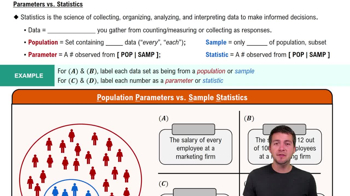
Parameters vs. Statistics

Sample Statistic

A sample statistic is a numerical value that summarizes a characteristic of a sample, which is a subset of the population. It is used to estimate the corresponding population parameter. For instance, if we surveyed a few governors and found that 54% of them were Republicans, this would be a sample statistic, as it is derived from a smaller group rather than the entire population of governors.
Recommended video:
05:11
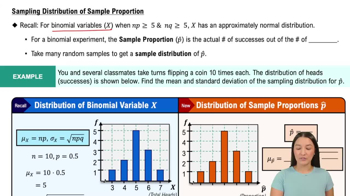
Sampling Distribution of Sample Proportion

Distinction Between Parameter and Statistic

Understanding the distinction between a population parameter and a sample statistic is crucial in statistics. A parameter describes a whole population, while a statistic describes a sample drawn from that population. In the given question, the 54% figure refers to all governors, making it a population parameter, as it does not derive from a sample but rather encompasses the entire group.
Recommended video:
Guided course
05:53
Parameters vs. Statistics