Ch. 1 - Introduction to Statistics
Larson - Elementary Statistics: Picturing the World 8th Edition
Larson8th EditionElementary Statistics: Picturing the WorldISBN: 9780137493470Not the one you use?Change textbook
Chapter 1, Problem 1.3.20c

"Researchers in Japan tested the effect of cannabidiol (CBD) in treating late teenagers with social anxiety disorder (SAD). Thirty-seven 18- to 19-year-old teenagers with SAD took part in the study. The patients were assigned at random to receive a daily dose of either CBD or a placebo for 4 weeks. Symptoms were measured using The Fear of Negative Evaluation Questionnaire and the Liebowitz Social Anxiety Scale at the beginning and end of the treatment. (Source: Frontiers in Psychology)
The experiment is described as a placebo-controlled, double-blind study. Explain what this means."

Verified step by step guidance
1
A placebo-controlled study means that the participants are divided into two groups: one group receives the actual treatment (in this case, CBD), while the other group receives a placebo, which is a substance with no therapeutic effect. This allows researchers to compare the effects of the treatment against the placebo to determine if the treatment has a significant impact.
A double-blind study means that neither the participants nor the researchers administering the treatment know which participants are receiving the actual treatment and which are receiving the placebo. This helps to eliminate bias in the study, ensuring that the results are not influenced by the expectations of either the participants or the researchers.
The random assignment of participants to the treatment or placebo group ensures that the groups are comparable and that any differences in outcomes can be attributed to the treatment rather than pre-existing differences between the groups.
The use of standardized measurement tools, such as The Fear of Negative Evaluation Questionnaire and the Liebowitz Social Anxiety Scale, ensures that the symptoms of social anxiety disorder are assessed consistently and objectively before and after the treatment.
By combining these elements (placebo control, double-blind design, random assignment, and standardized measurement), the study aims to provide reliable and unbiased evidence about the effectiveness of CBD in treating social anxiety disorder in late teenagers.

Verified video answer for a similar problem:

This video solution was recommended by our tutors as helpful for the problem above.
Video duration:
3m
Was this helpful?

Key Concepts

Here are the essential concepts you must grasp in order to answer the question correctly.

Placebo-Controlled Study

A placebo-controlled study is a type of clinical trial where one group of participants receives the treatment being tested, while another group receives a placebo, which is an inactive substance. This design helps to isolate the effect of the treatment by comparing outcomes between the two groups, ensuring that any observed effects can be attributed to the treatment rather than psychological factors or expectations.
Recommended video:
Guided course
06:28
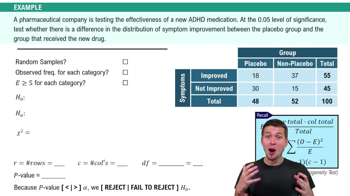
Homogeneity Test Example 1

Double-Blind Study

In a double-blind study, neither the participants nor the researchers know who is receiving the treatment and who is receiving the placebo. This design minimizes bias, as it prevents both parties from influencing the results or their interpretations. It enhances the reliability of the findings by ensuring that expectations do not affect the outcomes.

Random Assignment

Random assignment is the process of assigning participants to different groups in a study using randomization techniques. This ensures that each participant has an equal chance of being placed in any group, which helps to eliminate selection bias and ensures that the groups are comparable at the start of the experiment. This is crucial for the validity of the study's conclusions.
Recommended video:
Guided course
07:09
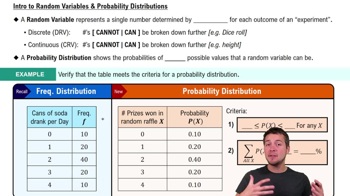
Intro to Random Variables & Probability Distributions
Related Practice
Textbook Question

Identify the sampling technique used, and discuss potential sources of bias (if any). Explain.

A student asks 18 friends to participate in a psychology experiment.

194
views

Textbook Question

A company wants to test the effectiveness of a new acne cream. The company recruits 500 girls ages 13 to 17 who have acne. The subjects are randomly assigned into two groups. One group is given the acne cream and the other is given a placebo that looks exactly like the acne cream. Both groups apply the cream daily for two months. Facial photos are taken at the beginning and end of the treatment to compare results.

b. Identify a potential problem with the experimental design being used and suggest a way to improve it.

202
views
Textbook Question

A company wants to test the effectiveness of a new acne cream. The company recruits 500 girls ages 13 to 17 who have acne. The subjects are randomly assigned into two groups. One group is given the acne cream and the other is given a placebo that looks exactly like the acne cream. Both groups apply the cream daily for two months. Facial photos are taken at the beginning and end of the treatment to compare results.

Identify the experimental units and treatments used in this experiment.

180
views
Textbook Question

"Researchers in Japan tested the effect of cannabidiol (CBD) in treating late teenagers with social anxiety disorder (SAD). Thirty-seven 18- to 19-year-old teenagers with SAD took part in the study. The patients were assigned at random to receive a daily dose of either CBD or a placebo for 4 weeks. Symptoms were measured using The Fear of Negative Evaluation Questionnaire and the Liebowitz Social Anxiety Scale at the beginning and end of the treatment. (Source: Frontiers in Psychology)

How could blocking be used in designing this experiment?"

41
views
Textbook Question

A company wants to test the effectiveness of a new acne cream. The company recruits 500 girls ages 13 to 17 who have acne. The subjects are randomly assigned into two groups. One group is given the acne cream and the other is given a placebo that looks exactly like the acne cream. Both groups apply the cream daily for two months. Facial photos are taken at the beginning and end of the treatment to compare results.

c. How could this experiment be designed to be double-blind?

217
views
Textbook Question

"Researchers in Japan tested the effect of cannabidiol (CBD) in treating late teenagers with social anxiety disorder (SAD). Thirty-seven 18- to 19-year-old teenagers with SAD took part in the study. The patients were assigned at random to receive a daily dose of either CBD or a placebo for 4 weeks. Symptoms were measured using The Fear of Negative Evaluation Questionnaire and the Liebowitz Social Anxiety Scale at the beginning and end of the treatment. (Source: Frontiers in Psychology)

Identify a potential problem with the experimental design being used and suggest a way to improve it."

41
views