Ch. 10 - Chi-Square Tests and the F-Distribution
Larson - Elementary Statistics: Picturing the World 8th Edition
Larson8th EditionElementary Statistics: Picturing the WorldISBN: 9780137493470Not the one you use?Change textbook
Chapter 10, Problem 10.2.12

Finding Expected Frequencies
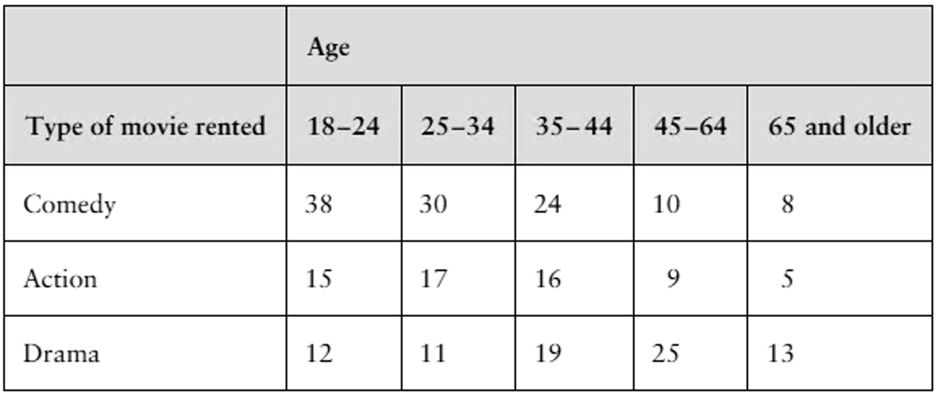
In Exercises 7–12, (a) calculate the marginal frequencies and (b) find the expected frequency for each cell in the contingency table. Assume that the variables are independent.


Contingency table showing movie rental frequency by age group and genre: Comedy, Action, and Drama.

Verified step by step guidance
1
Step 1: Calculate the marginal frequencies for each row (type of movie rented) by summing the values across all age groups. For example, for Comedy, sum 38 + 30 + 24 + 10 + 8.
Step 2: Calculate the marginal frequencies for each column (age group) by summing the values across all movie types. For example, for the age group 18–24, sum 38 + 15 + 12.
Step 3: Compute the grand total by summing all the values in the table. This is the sum of all marginal frequencies.
Step 4: Use the formula for expected frequency: \( E_{ij} = \frac{(R_i \times C_j)}{T} \), where \( R_i \) is the row total, \( C_j \) is the column total, and \( T \) is the grand total. Apply this formula to each cell in the table.
Step 5: Verify that the sum of all expected frequencies matches the grand total as a check for accuracy.

Verified video answer for a similar problem:

This video solution was recommended by our tutors as helpful for the problem above.
Video duration:
4m
Was this helpful?

Key Concepts

Here are the essential concepts you must grasp in order to answer the question correctly.

Marginal Frequencies

Marginal frequencies are the sums of the rows or columns in a contingency table, representing the total counts for each category. They provide a summary of the data, allowing for a quick understanding of the distribution of each variable independently. For example, in the given table, the marginal frequency for the 'Comedy' row is the total number of comedies rented across all age groups.
Recommended video:
04:41
Creating Frequency Polygons

Expected Frequencies

Expected frequencies are the theoretical counts that would occur in each cell of a contingency table if the variables were independent. They are calculated by multiplying the marginal totals of the corresponding row and column, then dividing by the overall total. This concept is crucial for conducting chi-square tests, as it helps determine if there is a significant association between the variables.
Recommended video:
Guided course
08:18
Contingency Tables & Expected Frequencies

Independence of Variables

The independence of variables means that the occurrence of one variable does not affect the occurrence of another. In the context of a contingency table, if the variables are independent, the expected frequencies can be calculated as described. Understanding this concept is essential for interpreting the results of statistical tests, as it underpins the assumptions made when analyzing the data.
Recommended video:
Guided course
06:28
Independence Test
Related Practice
Textbook Question

Performing a Two-Sample F-Test In Exercises 19–26, (a) identify the claim and state H0 and Ha, (b) find the critical value and identify the rejection region, (c) find the test statistic F, (d) decide whether to reject or fail to reject the null hypothesis, and (e) interpret the decision in the context of the original claim. Assume the samples are random and independent, and the populations are normally distributed.


Heart Transplant Waiting Times The table at the left shows a sample of the waiting times (in days) for a heart transplant for two age groups. At α=0.05, can you conclude that the variances of the waiting times differ between the two age groups? (Adapted from Organ Procurement and Transplantation Network)


41
views
Textbook Question

Performing a Two-Sample F-Test In Exercises 19–26, (a) identify the claim and state H0 and Ha, (b) find the critical value and identify the rejection region, (c) find the test statistic F, (d) decide whether to reject or fail to reject the null hypothesis, and (e) interpret the decision in the context of the original claim. Assume the samples are random and independent, and the populations are normally distributed.


Annual Salaries An employment information service claims that the standard deviation of the annual salaries for public relations managers is less in Louisiana than in Florida. You select a sample of public relations managers from each state. The results of each survey are shown in the figure. At α=0.05, can you support the service’s claim? (Adapted from America’s Career InfoNet)


47
views
Textbook Question

True or False? In Exercises 5 and 6, determine whether the statement is true or false. If it is false, rewrite it as a true statement.


When the test statistic for the chi-square independence test is large, you will, in most cases, reject the null hypothesis.

69
views
Textbook Question

"In Exercises 13–18, test the claim about the difference between two population variances σ₁² and σ₂² at the level of significance α. Assume the samples are random and independent, and the populations are normally distributed.


Claim: σ₁² = σ₂²; α = 0.05.

Sample statistics: s₁² = 310, n₁ = 7 and s₂² = 297, n₂ = 8"

64
views
Textbook Question

Testing for Normality Using a chi-square goodness-of-fit test, you can decide, with some degree of certainty, whether a variable is normally distributed. In all chi-square tests for normality, the null and alternative hypotheses are as listed below.


H₀: The variable has a normal distribution.


Hₐ: The variable does not have a normal distribution.


To determine the expected frequencies when performing a chi-square test for normality, first estimate the mean and standard deviation of the frequency distribution. Then, use the mean and standard deviation to compute the z-score for each class boundary. Then, use the z-scores to calculate the area under the standard normal curve for each class. Multiplying the resulting class areas by the sample size yields the expected frequency for each class.In Exercises 17 and 18, (a) find the expected frequencies, (b) find the critical value and identify the rejection region, (c) find the chi-square test statistic, (d) decide whether to reject or fail to reject the null hypothesis, and (e) interpret the decision in the context of the original claim.


In Exercises 17 and 18, (a) find the expected frequencies, (b) find the critical value and identify the rejection region, (c) find the chi-square test statistic, (d) decide whether to reject or fail to reject the null hypothesis, and (e) interpret the decision in the context of the original claim.


Test Scores At α=0.05, test the claim that the 400 test scores shown in the frequency distribution are normally distributed.


217
views
Textbook Question

Performing a Chi-Square Independence Test In Exercises 13–28, perform the indicated chi-square independence test by performing the steps below.

a. Identify the claim and state H₀ and Hₐ


b. Determine the degrees of freedom, find the critical value, and identify the rejection region.


c. Find the chi-square test statistic.


d. Decide whether to reject or fail to reject the null hypothesis.


e. Interpret the decision in the context of the original claim.


Choosing a College The contingency table shows the results of a survey asking 1858 parents and students of different incomes what their deciding factor was in choosing a college. At α=0.01, can you conclude that the deciding factor in choosing a college is related to the income of the family? (Adapted from Sallie Mae)


111
views