
Ch. 2 - Descriptive Statistics
Larson - Elementary Statistics: Picturing the World 8th Edition
Larson8th EditionElementary Statistics: Picturing the WorldISBN: 9780137493470Not the one you use?Change textbook
Chapter 2, Problem 2.5.55

Extending Concepts


Midquartile Another measure of position is called the midquartile. You can find the midquartile of a data set by using the formula below.
Midquartile = (Q₁ + Q₃) / 2
In Exercises 55 and 56, find the midquartile of the data set.


5 7 1 2 3 10 8 7 5 3

Verified step by step guidance
1
Step 1: Organize the data set in ascending order. The given data set is: 5, 7, 1, 2, 3, 10, 8, 7, 5, 3. When sorted, it becomes: 1, 2, 3, 3, 5, 5, 7, 7, 8, 10.
Step 2: Identify Q₁ (the first quartile) and Q₃ (the third quartile). Quartiles divide the data into four equal parts. Q₁ is the median of the lower half of the data (excluding the overall median), and Q₃ is the median of the upper half of the data (excluding the overall median).
Step 3: Find the median of the entire data set to split it into two halves. Since there are 10 data points, the median is the average of the 5th and 6th values in the sorted list. This helps divide the data into lower and upper halves.
Step 4: Calculate Q₁ by finding the median of the lower half (1, 2, 3, 3, 5). Similarly, calculate Q₃ by finding the median of the upper half (5, 7, 7, 8, 10).
Step 5: Use the formula for the midquartile: Midquartile = (Q₁ + Q₃) / 2. Substitute the values of Q₁ and Q₃ into the formula to find the midquartile.

Verified video answer for a similar problem:

This video solution was recommended by our tutors as helpful for the problem above.
Video duration:
3m
Was this helpful?

Key Concepts

Here are the essential concepts you must grasp in order to answer the question correctly.

Midquartile

The midquartile is a measure of central tendency that represents the average of the first quartile (Q₁) and the third quartile (Q₃) of a data set. It provides insight into the spread and center of the data, particularly in skewed distributions. The formula for calculating the midquartile is (Q₁ + Q₃) / 2, which helps to summarize the data's overall position.

Quartiles

Quartiles are values that divide a data set into four equal parts, each containing 25% of the data. The first quartile (Q₁) is the median of the lower half of the data, while the third quartile (Q₃) is the median of the upper half. Understanding quartiles is essential for calculating the midquartile and analyzing the distribution of data.
Recommended video:
Guided course
04:51
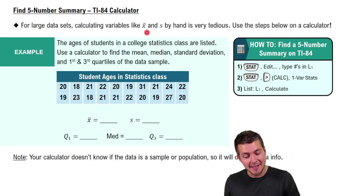
Find 5-Number Summary - TI-84 Calculator

Data Set

A data set is a collection of values or observations that can be analyzed statistically. In the context of the question, the data set consists of the numbers provided (5, 7, 1, 2, 3, 10, 8, 7, 5, 3). Analyzing a data set involves organizing, summarizing, and interpreting the data to extract meaningful insights, such as calculating measures like the midquartile.
Recommended video:
Guided course
04:39
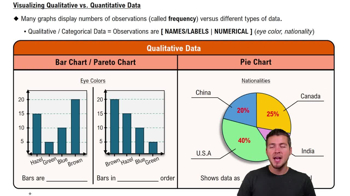
Visualizing Qualitative vs. Quantitative Data
Related Practice
Textbook Question

Construct a cumulative frequency distribution and an ogive for the data set using six classes. Then describe the location of the greatest increase in frequency.

Retirement Ages

Data set: Retirement ages of 35 English professors 72 62 55 61 53 62 65 66 69 55 66 63 67 69 55 65 67 57 67 68 73 75 65 54 71 57 52 58 58 71 72 67 63 65 61

182
views
Textbook Question

Identifying the Shape of a Distribution In Exercises 53–56, construct a frequency distribution and a frequency histogram for the data set using the indicated number of classes. Describe the shape of the histogram as symmetric, uniform, negatively skewed, positively skewed, or none of these.


Heights of Males

Number of classes: 5

Data set: The heights (to the nearest inch) of 30 males

67 76 69 68 72 68 65 63 75 69

66 72 67 66 69 73 64 62 71 73

68 72 71 65 69 66 74 72 68 69

265
views
Textbook Question

Graphing Data Sets In Exercises 17–32, organize the data using the indicated type of graph. Describe any patterns.


Engineering Degrees Use a time series chart to display the data shown in the table. The data represent the number of bachelor’s degrees in engineering (in thousands) conferred in the U.S. (Source: U.S. Deapartment of Education)


122
views
Textbook Question

The mean annual salary for a sample of electrical engineers is \$86,500, with a standard deviation of \(1500. The data set has a bell-shaped distribution.


b. The salaries of three randomly selected electrical engineers are \)93,500, \$85,600, and \$82,750. Find the z-score that corresponds to each salary. Determine whether any of these salaries are unusual.

78
views
Textbook Question

Tail lengths (in feet) for a sample of American alligators are listed.

6.5 3.4 4.2 7.1 5.4 6.8 7.5 3.9 4.6


a. Find the mean, median, and mode of the tail lengths. Which best describes a typical American alligator tail length? Explain your reasoning.

84
views
Textbook Question

You are a member of your local apartment association. The association represents rental housing owners and managers who operate residential rental property throughout the greater metropolitan area. Recently, the association has received several complaints from tenants in a particular area of the city who feel that their monthly rental fees are much higher compared to other parts of the city.

You want to investigate the rental fees. You gather the data shown in the table at the right. Area A represents the area of the city where tenants are unhappy about their monthly rents. The data represent the monthly rents paid by a random sample of tenants in Area A and three other areas of similar size. Assume all the apartments represented are approximately the same size with the same amenities.

c. Based on your data displays, does it appear that the monthly rents in Area A are higher than the rents in the other areas of the city? Explain.

80
views