Ch. 2 - Descriptive Statistics
Larson - Elementary Statistics: Picturing the World 8th Edition
Larson8th EditionElementary Statistics: Picturing the WorldISBN: 9780137493470Not the one you use?Change textbook
Chapter 2, Problem 2.3.46

Finding a Weighted Mean In Exercises 41– 46, find the weighted mean of the data.


Grades A student receives the grades shown below, with an A worth 4 points, a B worth 3 points, a C worth 2 points, and a D worth 1 point. What is the student’s grade point average?


Table showing a student's grades and class credits: A in 1 four-credit class, B in 2 three-credit classes, C in 1 three-credit class, D in 1 two-credit class.

Verified step by step guidance
1
Step 1: Understand the problem. The goal is to calculate the weighted mean, which is the grade point average (GPA) based on the grades and their corresponding credit hours. Each grade has a point value: A = 4, B = 3, C = 2, D = 1.
Step 2: Multiply each grade's point value by the number of credit hours for the corresponding class to find the weighted contribution of each grade. For example, for the A grade in a 4-credit class, the contribution is 4 × 4.
Step 3: Add up all the weighted contributions from Step 2. This gives the total weighted points.
Step 4: Add up all the credit hours from the classes. For example, the total credit hours are 4 (A) + 6 (B) + 3 (C) + 2 (D).
Step 5: Divide the total weighted points (from Step 3) by the total credit hours (from Step 4) to calculate the weighted mean, which is the GPA.

Verified video answer for a similar problem:

This video solution was recommended by our tutors as helpful for the problem above.
Video duration:
2m
Was this helpful?

Key Concepts

Here are the essential concepts you must grasp in order to answer the question correctly.

Weighted Mean

The weighted mean is a type of average that takes into account the relative importance or weight of each value in a dataset. In this context, each grade is assigned a point value, and the number of credits for each class serves as the weight. The formula for the weighted mean is the sum of the products of each value and its weight, divided by the total weight.
Recommended video:
Guided course
04:52
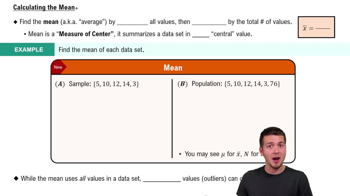
Calculating the Mean

Grade Point Average (GPA)

The Grade Point Average (GPA) is a numerical representation of a student's academic performance, calculated by averaging the weighted grades received in courses. Each letter grade corresponds to a specific point value (A=4, B=3, C=2, D=1), and the GPA is computed by multiplying these point values by the credit hours of each course, summing the results, and dividing by the total credit hours.
Recommended video:
08:22
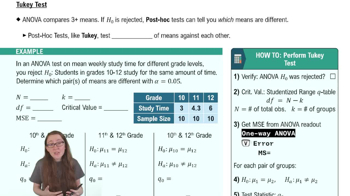
Tukey Test

Credits

Credits represent the value assigned to a course, reflecting the amount of time and effort required to complete it. In this scenario, different classes have varying credit values, which influence the calculation of the GPA. The more credits a class has, the greater its impact on the overall GPA, as it contributes more weight to the average.
Recommended video:
Guided course
02:35
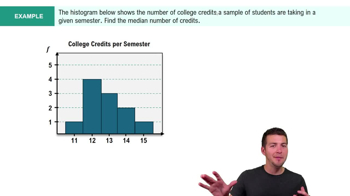
Calculating the Median Example 1
Related Practice
Textbook Question

Finding the Mean of a Frequency Distribution In Exercises 49–52, approximate the mean of the frequency distribution.


Social Media The average daily amounts of time (in minutes) spent on Snapchat

267
views

Textbook Question

What is the difference between a frequency polygon and an ogive?

418
views
Textbook Question

Finding and Interpreting Percentiles In Exercises 37– 40, use the data set, which represents wait times (in minutes) for various services at a state’s Department of Motor Vehicles locations.

6 10 1 22 23 10 6 7 2 1 6 6 2 4 14 15 16 4

19 3 19 26 5 3 4 7 6 10 9 10 20 18 3 20 10 13

14 11 14 17 4 27 4 8 4 3 26 18 21 1 3 3 5 5

Which wait time represents the 50th percentile? How would you interpret this?

279
views
Textbook Question

Finding z-Scores The distribution of the ages of the winners of the Tour de France from 1903 to 2020 is approximately bell-shaped. The mean age is 27.9 years, with a standard deviation of 3.4 years. In Exercises 43–48, use the corresponding z-score to determine whether the age is unusual. Explain your reasoning. (Source: Le Tour de France)


100
views
Textbook Question

Finding the Mean of a Frequency Distribution In Exercises 49–52, approximate the mean of the frequency distribution.


Populations The populations (in thousands) of the counties in Montana in 2019 (Source: U.S. Census Bureau)

126
views
Textbook Question

Comparing Variation in Different Data Sets In Exercises 45–50, find the coefficient of variation for each of the two data sets. Then compare the results.

Annual Salaries Sample annual salaries (in thousands of dollars) for entry level architects in Denver, CO, and Los Angeles, CA, are listed.

156
views