Ch. 2 - Descriptive Statistics
Larson - Elementary Statistics: Picturing the World 8th Edition
Larson8th EditionElementary Statistics: Picturing the WorldISBN: 9780137493470Not the one you use?Change textbook
Chapter 2, Problem 2.5.13

Graphical Analysis In Exercises 13 and 14, use the box-and-whisker plot to identify the five-number summary.
Box-and-whisker plot showing a five-number summary with values 0, 2, 5, 8, and 10 on a number line.

Verified step by step guidance
1
Step 1: Understand the components of the box-and-whisker plot. The five-number summary consists of the minimum, first quartile (Q1), median (Q2), third quartile (Q3), and maximum values.
Step 2: Identify the minimum value. This is the smallest point on the left whisker, which corresponds to 0 in the plot.
Step 3: Identify the first quartile (Q1). This is the left edge of the box, which corresponds to 2 in the plot.
Step 4: Identify the median (Q2). This is the line inside the box, which corresponds to 5 in the plot.
Step 5: Identify the third quartile (Q3) and maximum value. The right edge of the box corresponds to Q3 (8), and the largest point on the right whisker corresponds to the maximum value (10).

Verified video answer for a similar problem:

This video solution was recommended by our tutors as helpful for the problem above.
Video duration:
3m
Was this helpful?

Key Concepts

Here are the essential concepts you must grasp in order to answer the question correctly.

Box-and-Whisker Plot

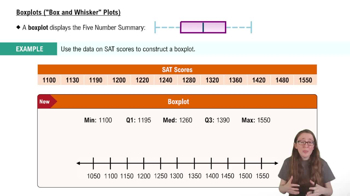
A box-and-whisker plot is a graphical representation of a dataset that displays its five-number summary: minimum, first quartile (Q1), median, third quartile (Q3), and maximum. The 'box' represents the interquartile range (IQR), which contains the middle 50% of the data, while the 'whiskers' extend to the minimum and maximum values. This visualization helps in understanding the distribution, central tendency, and variability of the data.
Recommended video:
03:54
Boxplots ("Box and Whisker Plots")

Five-Number Summary

The five-number summary consists of five key statistics that provide a quick overview of a dataset's distribution. It includes the minimum value, first quartile (Q1), median (Q2), third quartile (Q3), and maximum value. This summary is essential for understanding the spread and center of the data, and it is often used in conjunction with box-and-whisker plots to visualize these statistics.
Recommended video:
Guided course
04:51
Find 5-Number Summary - TI-84 Calculator

Quartiles

Quartiles are values that divide a dataset into four equal parts, each containing 25% of the data points. The first quartile (Q1) is the median of the lower half of the data, the second quartile (Q2) is the overall median, and the third quartile (Q3) is the median of the upper half. Quartiles are crucial for understanding the distribution and spread of data, particularly in identifying outliers and the interquartile range.
Recommended video:
07:11
Percentiles and Quartiles
Related Practice
Textbook Question

Grades In Exercise 46, one of the student’s B grades gets changed to an A. What is the student’s new grade point average?

133
views

Textbook Question

Putting Graphs in Context In Exercises 5–8, match the plot with the description of the sample.

a. Times (in minutes) it takes a sample of employees to drive to work

b. Grade point averages of a sample of students with finance majors

c. Top speeds (in miles per hour) of a sample of high-performance sports cars

d. Ages (in years) of a sample of residents of a retirement home


" style="" width="385">

91
views
Textbook Question

Graphical Analysis In Exercises 59 and 60, the letters A, B, and C are marked on the horizontal axis. Describe the shape of the data. Then determine which is the mean, which is the median, and which is the mode. Justify your answers.


" style="" width="270">

80
views
Textbook Question

Graphing Data Sets In Exercises 17–32, organize the data using the indicated type of graph. Describe any patterns.


Life Spans of Houseflies Use a dot plot to display the data, which represent the life spans (in days) of 30 houseflies. 

9 9 4 11 10 5 13 9 7 11 6 8 14 10 6 

10 10 7 14 11 7 8 6 13 10 14 14 8 13 10

188
views
Textbook Question

Using and Interpreting Concepts


Finding and Discussing the Mean, Median, and Mode In Exercises 17–34, find the mean, the median, and the mode of the data, if possible. If any measure cannot be found or does not represent the center of the data, explain why.


Power Failures The durations (in minutes) of power failures at a residence in the last 10 years

18 26 45 75 125 80 33

40 44 49 89 80 96 125

12 61 31 63 103 28 19

100
views
Textbook Question

Constructing a Frequency Distribution and a Frequency Polygon In Exercises 35 and 36, construct a frequency distribution and a frequency polygon for the data set using the indicated number of classes. Describe any patterns.

Ages of the Presidents Number of classes: 7 Data set: Ages of the U.S. presidents at Inauguration (Source: The White House) 57 61 57 57 58 57 61 54 68 51 49 64 50 48 65 52 56 46 54 49 51 47 55 55 54 42 51 56 55 51 54 51 60 62 43 55 56 61 52 69 64 46 54 47 70 78

94
views