
Graphical Analysis In Exercises 21–24, you are asked to compare three data sets.
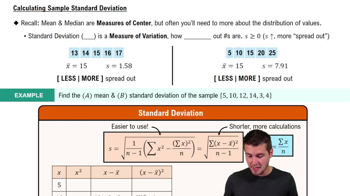
(c) Estimate the sample standard deviations. Then determine how close each of your estimates is by finding the sample standard deviations.
i.
ii.
iii.
Verified step by step guidance
Graphical Analysis In Exercises 21–24, you are asked to compare three data sets.
(c) Estimate the sample standard deviations. Then determine how close each of your estimates is by finding the sample standard deviations.
i.
ii.
iii.
Using and Interpreting Concepts
Using and Interpreting Concepts Finding Quartiles, Interquartile Range, and Outliers In Exercises 11 and 12,
(b) find the interquartile range
56 63 51 60 57 60 60 54 63 59 80 63 60 62 65
Mean Absolute Deviation Another useful measure of variation for a data set is the mean absolute deviation (MAD). It is calculated by the formula
MAD = Σ |x − x̄| / n.
b. Find the mean absolute deviation of the data set in Exercise 16. Compare your result with the sample standard deviation obtained in Exercise 16.
Life Spans of Tires A brand of automobile tire has a mean life span of 35,000 miles, with a standard deviation of 2250 miles. Assume the life spans of the tires have a bell-shaped distribution.
b. The life spans of three randomly selected tires are 30,500 miles, 37,250 miles, and 35,000 miles. Using the Empirical Rule, find the percentile that corresponds to each life span.
Extending Concepts
Trimmed Mean To find the 10% trimmed mean of a data set, order the data, delete the lowest 10% of the entries and the highest 10% of the entries, and find the mean of the remaining entries.
c. What is the benefit of using a trimmed mean versus using a mean found using all data entries? Explain your reasoning.
Extending Concepts
Golf The distances (in yards) for nine holes of a golf course are listed.
336 393 408 522 147 504 177 375 360
c. Compare the measures you found in part (b) with those found in part (a). What do you notice?