Ch. 2 - Descriptive Statistics
Larson - Elementary Statistics: Picturing the World 8th Edition
Larson8th EditionElementary Statistics: Picturing the WorldISBN: 9780137493470Not the one you use?Change textbook
Chapter 2, Problem 2.1.27c

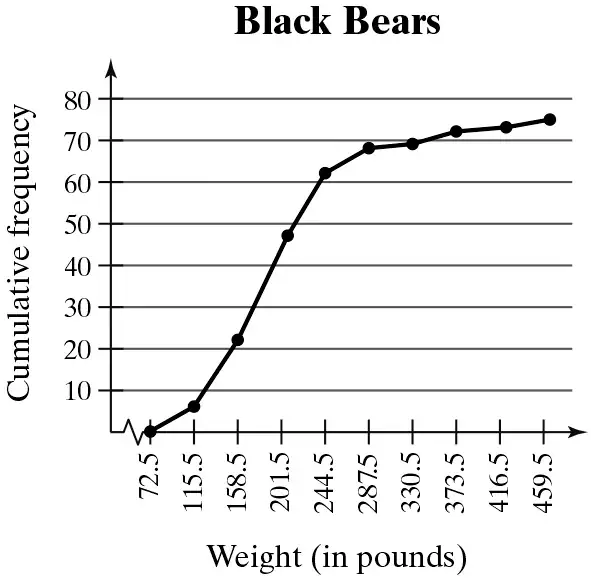
Use the ogive to approximate the
the number of black bears that weigh between 158.5 pounds and 244.5 pounds.
Cumulative frequency graph showing black bear weights, indicating data between 158.5 and 244.5 pounds.

Verified step by step guidance
1
Step 1: Understand the ogive graph. An ogive is a cumulative frequency graph that shows the cumulative number of observations below a certain value. The x-axis represents the weight of black bears, and the y-axis represents the cumulative frequency.
Step 2: Identify the cumulative frequency corresponding to the lower weight limit (158.5 pounds). Locate 158.5 on the x-axis and find the corresponding cumulative frequency on the y-axis by observing the graph.
Step 3: Identify the cumulative frequency corresponding to the upper weight limit (244.5 pounds). Locate 244.5 on the x-axis and find the corresponding cumulative frequency on the y-axis by observing the graph.
Step 4: Subtract the cumulative frequency at 158.5 pounds from the cumulative frequency at 244.5 pounds. This difference represents the number of black bears whose weights fall between 158.5 pounds and 244.5 pounds.
Step 5: Interpret the result. The difference calculated in Step 4 gives the approximate number of black bears within the specified weight range based on the ogive graph.

Verified video answer for a similar problem:

This video solution was recommended by our tutors as helpful for the problem above.
Video duration:
2m
Was this helpful?

Key Concepts

Here are the essential concepts you must grasp in order to answer the question correctly.

Ogive

An ogive is a cumulative frequency graph that represents the number of observations below a particular value in a dataset. It is constructed by plotting cumulative frequencies against the upper boundaries of the class intervals. This graph helps in visualizing the distribution of data and allows for easy determination of how many observations fall within a specific range.

Cumulative Frequency

Cumulative frequency is the running total of frequencies in a dataset, showing the number of observations that fall below or at a certain value. It is calculated by adding the frequency of each class interval to the sum of the frequencies of all preceding intervals. This concept is essential for understanding how data accumulates and is crucial for interpreting ogives.
Recommended video:
04:41
Creating Frequency Polygons

Interpreting Data Ranges

Interpreting data ranges involves analyzing specific intervals within a dataset to understand the distribution of values. In the context of the question, determining the number of black bears weighing between 158.5 and 244.5 pounds requires identifying the cumulative frequencies at these weight thresholds on the ogive. This allows for the calculation of the number of bears within that weight range by subtracting the cumulative frequencies.
Recommended video:
Guided course
04:39
Visualizing Qualitative vs. Quantitative Data
Related Practice
Textbook Question

Using and Interpreting Concepts


Using and Interpreting Concepts Finding Quartiles, Interquartile Range, and Outliers In Exercises 11 and 12,

(c) identify any outliers.


56 63 51 60 57 60 60 54 63 59 80 63 60 62 65

147
views

Textbook Question

Use the data set and the indicated number of classes to construct

(c) a frequency polygon,


Hospitals

Number of classes: 8

Data set: Number of hospitals in each of the 50 U.S. states and 5 inhabited territories (Source: American Hospital Directory) 10 90 51 1 77 341 56 34 8 214 111 3 14 40 18 142 102 55 75 108 72 53 19 105 55 83 1 69 19 108 10 27 14 78 37 31 186 146 90 37 177 52 11 67 25 100 361 35 91 2 7 61 78 33 14

59
views
Textbook Question

Graphical Analysis In Exercises 21–24, you are asked to compare three data sets.


(c) Estimate the sample standard deviations. Then determine how close each of your estimates is by finding the sample standard deviations.


i.

ii.

iii.

93
views
Textbook Question

Use the relative frequency histogram to describe any patterns with the data.

" style="" width="320">

175
views
Textbook Question

What Would You Do? The admissions department for a college is asked to recommend the minimum SAT scores that the college will accept for full-time students. The SAT scores of 50 applicants are listed. 1170 1000 910 870 1070 1290 920 1470 1080 1180 770 900 1120 1070 1370 1160 970 930 1240 1270 1250 1330 1010 1010 1410 1130 1210 1240 960 820 650 1010 1190 1500 1400 1270 1310 1050 950 1150 1450 1290 1310 1100 1330 1410 840 1040 1090 1080

If you want to accept the top 88% of the applicants, what should the minimum score be? Explain.

118
views
Textbook Question

What Would You Do? You work at a bank and are asked to recommend the amount of cash to put in an ATM each day. You do not want to put in too much (which would cause security concerns) or too little (which may create customer irritation). The daily withdrawals (in hundreds of dollars) for 30 days are listed. 72 84 61 76 104 76 86 92 80 88 98 76 97 82 84 67 70 81 82 89 74 73 86 81 85 78 82 80 91 83

If you are willing to run out of cash on 10% of the days, how much cash should you put in the ATM each day? Explain.

156
views