
Ch. 3 - Probability
Larson - Elementary Statistics: Picturing the World 8th Edition
Larson8th EditionElementary Statistics: Picturing the WorldISBN: 9780137493470Not the one you use?Change textbook
Chapter 3, Problem 3.4.28

28. Necklaces You are putting nine blue glass beads, three red glass beads, and seven green glass beads on a necklace. In how many distinguishable ways can the colored beads be put on the necklace?

Verified step by step guidance
1
Step 1: Recognize that this is a permutation problem involving indistinguishable objects. Since the necklace is circular, we need to account for rotational symmetry, which reduces the number of unique arrangements.
Step 2: Calculate the total number of beads, which is the sum of blue, red, and green beads: 9 + 3 + 7 = 19 beads.
Step 3: Compute the total number of arrangements of the beads without considering rotational symmetry using the formula for permutations of multiset: \( \frac{n!}{n_1! \cdot n_2! \cdot n_3!} \), where \(n\) is the total number of beads, and \(n_1, n_2, n_3\) are the counts of each type of bead. Here, \(n = 19\), \(n_1 = 9\) (blue), \(n_2 = 3\) (red), and \(n_3 = 7\) (green).
Step 4: Adjust for rotational symmetry. For a circular arrangement, divide the result from Step 3 by the total number of beads (19) to account for rotations that produce identical arrangements.
Step 5: Simplify the expression obtained in Step 4 to determine the number of distinguishable arrangements of the beads on the necklace.

Verified video answer for a similar problem:

This video solution was recommended by our tutors as helpful for the problem above.
Video duration:
5m
Was this helpful?

Key Concepts

Here are the essential concepts you must grasp in order to answer the question correctly.

Permutations and Combinations

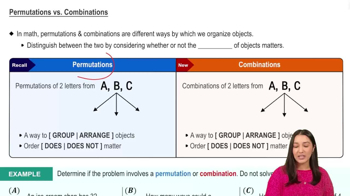
Permutations and combinations are fundamental concepts in combinatorics that deal with counting arrangements and selections of items. Permutations refer to the different ways to arrange a set of items where order matters, while combinations refer to selections where order does not matter. In this question, we need to consider the arrangements of beads, which involves permutations of multiset due to the presence of identical items.
Recommended video:
03:18
Permutations vs. Combinations

Multiset Permutations

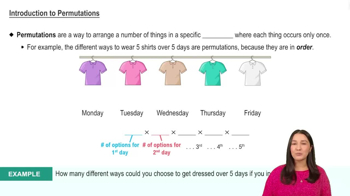
A multiset is a generalized concept of a set that allows for multiple occurrences of the same element. The formula for calculating the number of distinct permutations of a multiset is given by n! / (n1! * n2! * ... * nk!), where n is the total number of items, and n1, n2, ..., nk are the counts of each distinct item. This is crucial for solving the necklace problem, as it accounts for the indistinguishable beads of the same color.
Recommended video:
07:11
Introduction to Permutations

Circular Permutations

Circular permutations refer to arrangements of items in a circle, where rotations of the same arrangement are considered identical. The formula for circular permutations of n distinct items is (n-1)!. However, when dealing with indistinguishable items, adjustments must be made to account for the repetitions. In this necklace problem, we must apply the circular permutation concept to find the number of unique arrangements of the beads.
Recommended video:
07:11
Introduction to Permutations