Ch. 3 - Probability
Larson - Elementary Statistics: Picturing the World 8th Edition
Larson8th EditionElementary Statistics: Picturing the WorldISBN: 9780137493470Not the one you use?Change textbook
Chapter 3, Problem 3.1.3

3. Explain why the statement is incorrect: The probability of rain is 150%.

Verified step by step guidance
1
Step 1: Begin by explaining the concept of probability. Probability is a measure of the likelihood of an event occurring, expressed as a number between 0 and 1 (or equivalently, 0% to 100%). A probability of 0 means the event is impossible, while a probability of 1 (or 100%) means the event is certain.
Step 2: Clarify that probabilities cannot exceed 1 (or 100%). This is because probability represents a fraction of the total possible outcomes, and the total probability of all possible outcomes must sum to 1 (or 100%).
Step 3: Discuss why the statement 'The probability of rain is 150%' is incorrect. A probability of 150% exceeds the maximum possible value of 100%, which violates the fundamental definition of probability.
Step 4: Provide an example to reinforce the concept. For instance, if the probability of rain were 50%, it would mean there is a 50/100 chance of rain occurring. A probability of 150% would imply more than certainty, which is not logically or mathematically valid.
Step 5: Conclude by emphasizing that probabilities are always constrained within the range of 0 to 1 (or 0% to 100%), and any value outside this range is not meaningful in the context of probability theory.

Verified video answer for a similar problem:

This video solution was recommended by our tutors as helpful for the problem above.
Video duration:
1m
Was this helpful?

Key Concepts

Here are the essential concepts you must grasp in order to answer the question correctly.

Probability Range

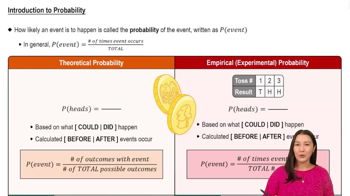
Probability is a measure of the likelihood of an event occurring, expressed as a number between 0 and 1, or as a percentage from 0% to 100%. A probability of 0% means the event will not happen, while 100% means it is certain to occur. Therefore, stating a probability of 150% exceeds this range and is mathematically invalid.
Recommended video:
5:37
Introduction to Probability

Understanding Percentages

Percentages represent a fraction of 100. When discussing probabilities, they indicate how likely an event is to occur out of 100 possible outcomes. A probability of 150% suggests that the event is more than certain, which is impossible, as it cannot exceed the totality of possible outcomes.
Recommended video:
Guided course
06:21
Step 1: Write Hypotheses

Interpretation of Weather Forecasts

Weather forecasts often express the probability of rain as a percentage, indicating the chance of rain occurring in a specific area over a given time. A probability of rain is based on historical data and meteorological models, and it should always fall within the 0% to 100% range to be meaningful and accurate.
Recommended video:
5:37
Introduction to Probability
Related Practice
Textbook Question

56. Defective Disks A pack of 100 recordable DVDs contains 5 defective disks. You select four disks. What is the probability of selecting at least three non defective disks?

83
views

Textbook Question

Odds The chances of winning are often written in terms of odds rather than probabilities. The odds of winning is the ratio of the number of successful outcomes to the number of unsuccessful outcomes. The odds of losing is the ratio of the number of unsuccessful outcomes to the number of successful outcomes. For example, when the number of successful outcomes is 2 and the number of unsuccessful outcomes is 3, the odds of winning are 2 : 3 (read "2 to 3"). In Exercises 91-96, use this information about odds.

94. A card is picked at random from a standard deck of 52 playing cards. Find the odds that it is a spade.

242
views
Textbook Question

Identifying the Sample Space of a Probability Experiment In Exercises 25-32, identify the sample space of the probability experiment and determine the number of outcomes in the sample space. Draw a tree diagram when appropriate.

32. Rolling a six-sided die, tossing two coins, and spinning the fair spinner shown

158
views
Textbook Question

Identifying Simple Events In Exercises 33-36, determine the number of outcomes in the event. Then decide whether the event is a simple event or not. Explain your reasoning.

34. A spreadsheet is used to randomly generate a number from 1 to 4000. Event B is generating a number less than 500.

112
views
Textbook Question

In Exercises 15-18, determine whether the situation involves permutations, combinations, or neither. Explain your reasoning.

17. The number of ways 2 captains can be chosen from 28 players on a lacrosse team

150
views
Textbook Question

"Classifying Events as Independent or Dependent In Exercises 9-14, determine whether the events are independent or dependent. Explain your reasoning.

10. A father having hazel eyes and a daughter having hazel eyes"

69
views