
Ch. 3 - Probability
Larson - Elementary Statistics: Picturing the World 8th Edition
Larson8th EditionElementary Statistics: Picturing the WorldISBN: 9780137493470Not the one you use?Change textbook
Chapter 3, Problem 3.4.50d

50. Investment Committee A company has 200 employees, consisting of 144 women and 56 men. The company wants to select five employees to serve as an investment committee.
d. Explain how the company can select a representative sample of the male and female population of employees.

Verified step by step guidance
1
Step 1: Understand the problem. The company wants to select a representative sample of 5 employees from a population of 200 employees, consisting of 144 women and 56 men. A representative sample means the proportion of men and women in the sample should reflect the proportions in the population.
Step 2: Calculate the proportion of women and men in the population. The proportion of women is given by dividing the number of women by the total number of employees: \( \text{Proportion of women} = \frac{144}{200} \). Similarly, calculate the proportion of men: \( \text{Proportion of men} = \frac{56}{200} \).
Step 3: Determine the number of women and men to include in the sample. Multiply the total sample size (5) by the proportion of women to find the number of women to include: \( \text{Number of women in sample} = 5 \times \frac{144}{200} \). Similarly, calculate the number of men to include: \( \text{Number of men in sample} = 5 \times \frac{56}{200} \).
Step 4: Round the results from Step 3 to the nearest whole numbers, ensuring the total adds up to 5. For example, if the calculations yield 3.6 women and 1.4 men, round to 4 women and 1 man, as this maintains the total sample size of 5.
Step 5: Use a random sampling method to select the specific individuals. For women, randomly select the calculated number of women (e.g., 4) from the 144 women. For men, randomly select the calculated number of men (e.g., 1) from the 56 men. This ensures the sample is both random and representative of the population proportions.

Verified video answer for a similar problem:

This video solution was recommended by our tutors as helpful for the problem above.
Video duration:
6m
Was this helpful?

Key Concepts

Here are the essential concepts you must grasp in order to answer the question correctly.

Sampling Methods

Sampling methods are techniques used to select individuals from a population to participate in a study. Common methods include random sampling, stratified sampling, and systematic sampling. In this context, the company can use stratified sampling to ensure that both men and women are represented proportionally in the selection of the investment committee.
Recommended video:
05:11
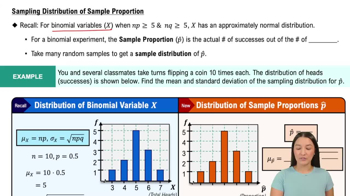
Sampling Distribution of Sample Proportion

Proportional Representation

Proportional representation refers to the practice of ensuring that different subgroups within a population are represented in the sample in the same proportion as they exist in the population. For the company, this means selecting committee members in a way that reflects the ratio of women to men among the employees, which is 72% women and 28% men.
Recommended video:
Guided course
09:27
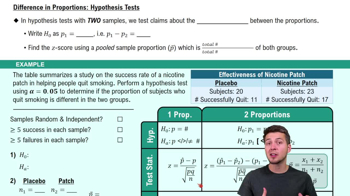
Difference in Proportions: Hypothesis Tests

Sample Size

Sample size is the number of individuals selected from a population for a study. It is crucial to determine an appropriate sample size to ensure that the sample accurately reflects the population. In this case, the company needs to decide how many men and women to select from the total of five committee members to maintain the proportional representation of the employee demographics.
Recommended video:
05:11
Sampling Distribution of Sample Proportion