Ch. 3 - Probability
Larson - Elementary Statistics: Picturing the World 8th Edition
Larson8th EditionElementary Statistics: Picturing the WorldISBN: 9780137493470Not the one you use?Change textbook
Chapter 3, Problem 3.2.33

According to Bayes’ Theorem, the probability of event A , given that event B has occurred, is
P(A|B) = P(A) * P(B|A)P(A) * P(B|A) + P(A') * P(B|A').
In Exercises 33–38, use Bayes’ Theorem to find P(A|B).
33. P(A) = 2/3, P(A') = 1/3, P(B|A) = 1/5 , and P(B|A') = 1/2

Verified step by step guidance
1
Step 1: Recall Bayes' Theorem formula: P(A|B) = (P(A) * P(B|A)) / (P(A) * P(B|A) + P(A') * P(B|A')). This formula helps us calculate the conditional probability of event A given that event B has occurred.
Step 2: Substitute the given values into the formula. From the problem, P(A) = 2/3, P(A') = 1/3, P(B|A) = 1/5, and P(B|A') = 1/2. The formula becomes: P(A|B) = ((2/3) * (1/5)) / ((2/3) * (1/5) + (1/3) * (1/2)).
Step 3: Simplify the numerator. Multiply P(A) and P(B|A): (2/3) * (1/5).
Step 4: Simplify the denominator. First, calculate (P(A) * P(B|A)) and (P(A') * P(B|A')). Then, add these two results together: ((2/3) * (1/5)) + ((1/3) * (1/2)).
Step 5: Divide the simplified numerator by the simplified denominator to find P(A|B). This will give you the conditional probability of A given B.

Verified video answer for a similar problem:

This video solution was recommended by our tutors as helpful for the problem above.
Video duration:
2m
Was this helpful?

Key Concepts

Here are the essential concepts you must grasp in order to answer the question correctly.

Bayes' Theorem

Bayes' Theorem is a fundamental principle in probability theory that describes how to update the probability of a hypothesis based on new evidence. It states that the probability of event A given event B, denoted as P(A|B), can be calculated using the formula P(A|B) = P(A) * P(B|A) / (P(A) * P(B|A) + P(A') * P(B|A')). This theorem is particularly useful in scenarios where prior knowledge about the events is available.

Conditional Probability

Conditional probability is the measure of the probability of an event occurring given that another event has already occurred. It is denoted as P(A|B), which represents the probability of event A occurring under the condition that event B is true. Understanding conditional probability is crucial for applying Bayes' Theorem, as it allows us to assess how the occurrence of one event influences the likelihood of another.
Recommended video:
5:37
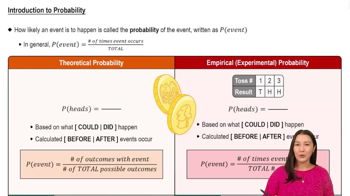
Introduction to Probability

Prior and Posterior Probabilities

In the context of Bayes' Theorem, prior probability refers to the initial assessment of the likelihood of an event before new evidence is considered, denoted as P(A). Posterior probability, on the other hand, is the updated probability of the event after taking into account the new evidence, represented as P(A|B). Distinguishing between these two types of probabilities is essential for correctly applying Bayes' Theorem to update beliefs based on new data.
Recommended video:
5:37
Introduction to Probability
Related Practice
Textbook Question

"True or False? In Exercises 5 and 6, determine whether the statement is true or false. If it is false, rewrite it as a true statement.

5. If two events are independent, then P(A|B) = P(B)."

37
views

Textbook Question

Finding Classical Probabilities In Exercises 41-46, a probability experiment consists of rolling a 12-sided die numbered 1 to 12. Find the probability of the event.

43. Event C: rolling a number greater than 4

164
views
Textbook Question

Matching Probabilities In Exercises 11-16, match the event with its probability.

a. 0.95

b. 0.005

c. 0.25

d. 0

e. 0.375

f. 0.5

11. A random number generator is used to select a number from 1 to 100. What is the probability of selecting the number 153?

111
views
Textbook Question

Classifying Events Based on Studies In Exercises 15-18, identify the two events described in the study. Do the results indicate that the events are independent or dependent? Explain your reasoning.

17. A study found that there is no relationship between playing violent video games and aggressive or bullying behavior in teenagers. (Source: The Royal Society Publishing)

74
views
Textbook Question

Cards In Exercises 59-62, you are dealt a hand of five cards from a standard deck of 52 playing cards.

59. Find the probability of being dealt two clubs and one of each of the other three suits.

116
views
Textbook Question

Finding the Probability of an Event In Exercises 21-24, the probability that an event will not happen is given. Find the probability that the event will happen. 

23. P(E')=3/4

256
views