
Ch. 4 - Discrete Probability Distributions
Larson - Elementary Statistics: Picturing the World 8th Edition
Larson8th EditionElementary Statistics: Picturing the WorldISBN: 9780137493470Not the one you use?Change textbook
Chapter 4, Problem 4.2.20

Finding Binomial Probabilities In Exercises 19–26, find the indicated probabilities. If convenient, use technology or Table 2 in Appendix B.


Civil Rights Fifty-nine percent of U.S. adults think that civil rights for Black Americans have improved during their lifetime. You randomly select seven U.S. adults. Find the probability that the number who think that civil rights for Black Americans have improved during their lifetime is (a) exactly one and (b) exactly five. (Source: Gallup)

Verified step by step guidance
1
Step 1: Identify the problem as a binomial probability problem. The binomial probability formula is given by: P(X = k) = C(n, k) * pk * (1 - p)n-k, where C(n, k) is the number of combinations, p is the probability of success, n is the number of trials, and k is the number of successes.
Step 2: Define the parameters of the problem. Here, the probability of success p = 0.59, the number of trials n = 7, and the number of successes k is either 1 (for part a) or 5 (for part b).
Step 3: Calculate the number of combinations C(n, k) using the formula C(n, k) = n! / (k! * (n - k)!). For part (a), calculate C(7, 1), and for part (b), calculate C(7, 5).
Step 4: Substitute the values into the binomial probability formula for each case. For part (a), substitute k = 1, p = 0.59, and n = 7. For part (b), substitute k = 5, p = 0.59, and n = 7. Ensure you calculate both pk and (1 - p)n-k.
Step 5: Use technology (such as a calculator or statistical software) or Table 2 in Appendix B to compute the probabilities for part (a) and part (b). This will give you the final probabilities for exactly one success and exactly five successes.

Verified video answer for a similar problem:

This video solution was recommended by our tutors as helpful for the problem above.
Video duration:
2m
Was this helpful?

Key Concepts

Here are the essential concepts you must grasp in order to answer the question correctly.

Binomial Distribution

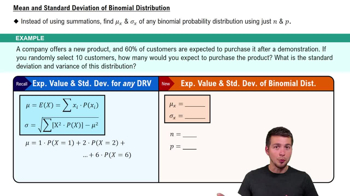
The binomial distribution models the number of successes in a fixed number of independent Bernoulli trials, each with the same probability of success. In this context, the 'success' is defined as a U.S. adult believing that civil rights for Black Americans have improved. The distribution is characterized by two parameters: the number of trials (n) and the probability of success (p).
Recommended video:
Guided course
03:28
Mean & Standard Deviation of Binomial Distribution

Probability Mass Function (PMF)

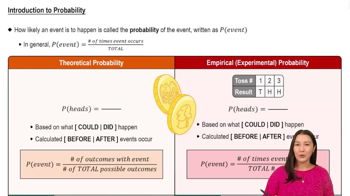
The probability mass function (PMF) of a binomial distribution gives the probability of obtaining exactly k successes in n trials. It is calculated using the formula P(X = k) = (n choose k) * p^k * (1-p)^(n-k), where 'n choose k' represents the binomial coefficient. This function is essential for determining the probabilities of specific outcomes, such as exactly one or exactly five successes in this scenario.
Recommended video:
5:37
Introduction to Probability

Binomial Coefficient

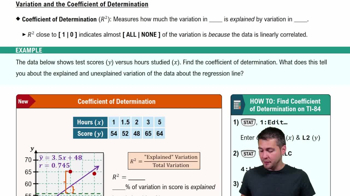
The binomial coefficient, denoted as 'n choose k' or C(n, k), represents the number of ways to choose k successes from n trials. It is calculated using the formula C(n, k) = n! / (k!(n-k)!), where '!' denotes factorial. This concept is crucial for calculating probabilities in binomial distributions, as it quantifies the different combinations of successes and failures.
Recommended video:
Guided course
06:14
Coefficient of Determination
Related Practice
Textbook Question

Finding and Interpreting Mean, Variance, and Standard Deviation In Exercises 31–36, find the mean, variance, and standard deviation of the binomial distribution for the given random variable. Interpret the results and determine any unusual values.


Late for Work Thirty-one percent of U.S. employees who are late for work blame oversleeping. You randomly select 12 U.S. employees who are late for work and ask them whether they blame oversleeping. The random variable represents the number who are late for work and blame oversleeping. (Source: CareerBuilder)

121
views
Textbook Question

Finding and Interpreting Mean, Variance, and Standard Deviation In Exercises 31–36, find the mean, variance, and standard deviation of the binomial distribution for the given random variable. Interpret the results and determine any unusual values.


Life on Other Planets Seventy-nine percent of U.S. adults believe that life on other planets is plausible. You randomly select eight U.S. adults and ask them whether they believe that life on other planets is plausible. The random variable represents the number who believe that life on other planets is plausible. (Source: Ipsos)

67
views
Textbook Question

Multinomial Experiments In Exercises 39 and 40, use the information below.

A multinomial experiment satisfies these conditions.

The experiment has a fixed number of trials n, where each trial is independent of the other trials.

Each trial has k possible mutually exclusive outcomes:

Each outcome has a fixed probability. So, . The sum of the probabilities for all outcomes is

The number of times occurs is , the number of times occurs is , the number of times occurs is , and so on.

The discrete random variable x counts the number of times that each outcome occurs in n independent trials where . The probability that x will occur is

Genetics According to a theory in genetics, when tall and colorful plants are crossed with short and colorless plants, four types of plants will result: tall and colorful, tall and colorless, short and colorful, and short and colorless, with corresponding probabilities of , and . Ten plants are selected. Find the probability that 5 will be tall and colorful, 2 will be tall and colorless, 2 will be short and colorful, and 1 will be short and colorless.

124
views
Textbook Question

Determining a Missing Probability In Exercises 25 and 26, determine the missing probability for the probability distribution.

116
views
Textbook Question

"Using a Distribution to Find Probabilities In Exercises 11–26, find the indicated probabilities using the geometric distribution, the Poisson distribution, or the binomial distribution. Then determine whether the events are unusual. If convenient, use a table or technology to find the probabilities.


Typographical Errors A newspaper finds that the mean number of typographical errors per page is four. Find the probability that the number of typographical errors found on any given page is (a) exactly three, (b) at most three, and (c) more than three."

100
views
Textbook Question

Graphical Analysis In Exercises 9–12, determine whether the graph on the number line represents a discrete random variable or a continuous random variable. Explain your reasoning.


The distance a baseball travels after being hit

75
views