
Ch. 4 - Discrete Probability Distributions
Larson - Elementary Statistics: Picturing the World 8th Edition
Larson8th EditionElementary Statistics: Picturing the WorldISBN: 9780137493470Not the one you use?Change textbook
Chapter 4, Problem 4.RE.15c

In Exercises 13–16, find the indicated binomial probabilities. If convenient, use technology or Table 2 in Appendix B.
Seventy-two percent of U.S. civilian employees have access to medical care benefits. You randomly select nine civilian employees. Find the probability that the number who have access to medical care benefits is (c) more than six.

Verified step by step guidance
1
Step 1: Identify the problem type. This is a binomial probability problem because there are a fixed number of trials (n = 9), two possible outcomes (having access to medical care benefits or not), and a constant probability of success (p = 0.72).
Step 2: Define the random variable X. Let X represent the number of employees (out of 9) who have access to medical care benefits. X follows a binomial distribution: X ~ Binomial(n = 9, p = 0.72).
Step 3: Translate the problem into a probability statement. The problem asks for the probability that more than six employees have access to medical care benefits. This can be written as P(X > 6).
Step 4: Use the complement rule to simplify the calculation. P(X > 6) can be rewritten as 1 - P(X ≤ 6). This means you need to calculate the cumulative probability P(X ≤ 6) and subtract it from 1.
Step 5: Use the binomial probability formula or technology to calculate P(X ≤ 6). The binomial probability formula is P(X = k) = (n choose k) * p^k * (1-p)^(n-k), where 'n choose k' is the binomial coefficient. Sum the probabilities for X = 0, 1, 2, ..., 6 to find P(X ≤ 6), then subtract this value from 1 to get P(X > 6). Alternatively, use a statistical calculator or software to compute P(X > 6) directly.

Verified video answer for a similar problem:

This video solution was recommended by our tutors as helpful for the problem above.
Video duration:
5m
Was this helpful?

Key Concepts

Here are the essential concepts you must grasp in order to answer the question correctly.

Binomial Distribution

The binomial distribution models the number of successes in a fixed number of independent Bernoulli trials, each with the same probability of success. In this context, a 'success' is defined as an employee having access to medical care benefits. The distribution is characterized by two parameters: the number of trials (n) and the probability of success (p).
Recommended video:
Guided course
03:28
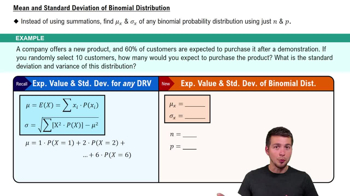
Mean & Standard Deviation of Binomial Distribution

Probability Calculation

To find the probability of a specific number of successes in a binomial distribution, we use the binomial probability formula: P(X = k) = (n choose k) * p^k * (1-p)^(n-k). Here, 'n choose k' represents the number of ways to choose k successes from n trials, p is the probability of success, and (1-p) is the probability of failure. This formula allows us to calculate the likelihood of different outcomes.
Recommended video:
Guided course
07:09
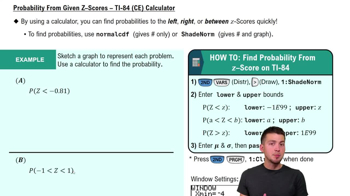
Probability From Given Z-Scores - TI-84 (CE) Calculator

Cumulative Probability

Cumulative probability refers to the probability that a random variable takes on a value less than or equal to a certain threshold. In this case, to find the probability that more than six employees have access to medical care benefits, we can calculate the cumulative probability for six or fewer employees and subtract it from one. This approach simplifies the calculation by leveraging previously computed probabilities.
Recommended video:
5:37
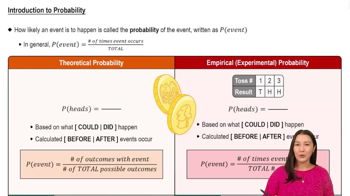
Introduction to Probability
Related Practice
Textbook Question

In Exercises 21–26, find the indicated probabilities using the geometric distribution, the Poisson distribution, or the binomial distribution. Then determine whether the events are unusual. If convenient, use a table or technology to find the probabilities.

Fourteen percent of noninstitutionalized U.S. adults smoke cigarettes. After randomly selecting ten noninstitutionalized U.S. adults, you ask them whether they smoke cigarettes. Find the probability that the first adult who smokes cigarettes is (b) the fourth or fifth person selected.

103
views
Textbook Question

In Exercises 13–16, find the indicated binomial probabilities. If convenient, use technology or Table 2 in Appendix B.

Seventy-two percent of U.S. civilian employees have access to medical care benefits. You randomly select nine civilian employees. Find the probability that the number who have access to medical care benefits is (b) at least six

89
views
Textbook Question

In Exercises 11 and 12, determine whether the experiment is a binomial experiment. If it is, identify a success; specify the values of n, p, and q; and list the possible values of the random variable x. If it is not a binomial experiment, explain why.


A fair coin is tossed repeatedly until 15 heads are obtained. The random variable x counts the number of tosses.

130
views
Textbook Question

In Exercises 13–16, find the indicated binomial probabilities. If convenient, use technology or Table 2 in Appendix B.

Fifty-three percent of U.S. adults support attempting to land an astronaut on Mars. You randomly select eight U.S. adults. Find the probability that the number who support attempting to land an astronaut on Mars is (b) at least three

105
views
Textbook Question

In Exercises 13–16, find the indicated binomial probabilities. If convenient, use technology or Table 2 in Appendix B.

Seventy-two percent of U.S. civilian employees have access to medical care benefits. You randomly select nine civilian employees. Find the probability that the number who have access to medical care benefits is (a) exactly six

87
views
Textbook Question

In Exercises 13–16, find the indicated binomial probabilities. If convenient, use technology or Table 2 in Appendix B.

Fifty-three percent of U.S. adults support attempting to land an astronaut on Mars. You randomly select eight U.S. adults. Find the probability that the number who support attempting to land an astronaut on Mars is (c) more than three.

85
views