Ch. 4 - Discrete Probability Distributions
Larson - Elementary Statistics: Picturing the World 8th Edition
Larson8th EditionElementary Statistics: Picturing the WorldISBN: 9780137493470Not the one you use?Change textbook
Chapter 4, Problem 4.1.3

Is the expected value of the probability distribution of a random variable always one of the possible values of x? Explain.v

Verified step by step guidance
1
Understand the concept of expected value: The expected value (E[X]) of a random variable X is a weighted average of all possible values of X, where the weights are the probabilities associated with each value. It is calculated using the formula: E[X] = Σ (xᵢ * P(xᵢ)), where xᵢ represents the possible values of X and P(xᵢ) is the probability of xᵢ.
Recognize that the expected value is not necessarily one of the possible values of X: Since the expected value is a weighted average, it can be a value that does not correspond to any specific xᵢ in the probability distribution. For example, if the probabilities and values are distributed in such a way that the average lies between two possible values, the expected value will not match any specific xᵢ.
Consider an example to illustrate: Suppose a random variable X has possible values {1, 2, 3} with probabilities {0.2, 0.5, 0.3}. The expected value is calculated as E[X] = (1 * 0.2) + (2 * 0.5) + (3 * 0.3). The result may not be exactly 1, 2, or 3, but rather a value in between.
Understand the implications: The expected value represents the 'center' or 'balance point' of the probability distribution, but it does not have to correspond to an actual observed value of the random variable. This is a key distinction between the expected value and the mode or median, which may correspond to actual observed values.
Conclude with the answer: No, the expected value of a probability distribution is not always one of the possible values of X. It depends on the specific probabilities and values in the distribution, and it is often a value that lies between the possible values of X.

Verified video answer for a similar problem:

This video solution was recommended by our tutors as helpful for the problem above.
Video duration:
1m
Was this helpful?

Key Concepts

Here are the essential concepts you must grasp in order to answer the question correctly.

Expected Value

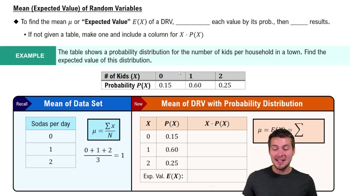
The expected value of a random variable is a measure of the central tendency of its probability distribution. It is calculated as the weighted average of all possible values, where each value is weighted by its probability of occurrence. The expected value provides a single summary statistic that represents the long-term average outcome of a random process.
Recommended video:
Guided course
04:14
Expected Value (Mean) of Random Variables

Probability Distribution

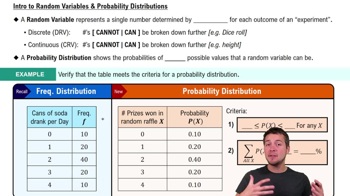
A probability distribution describes how the probabilities of a random variable are distributed across its possible values. It can be represented in various forms, such as a probability mass function for discrete variables or a probability density function for continuous variables. Understanding the shape and characteristics of a probability distribution is crucial for interpreting the expected value and other statistical measures.
Recommended video:
Guided course
06:39
Calculating Probabilities in a Binomial Distribution

Random Variable

A random variable is a numerical outcome of a random phenomenon, which can take on different values based on the outcome of a random process. Random variables can be classified as discrete, taking on specific values, or continuous, taking on any value within a range. The expected value of a random variable does not have to be one of its possible values; it can be a theoretical average that may not correspond to any actual outcome.
Recommended video:
Guided course
07:09
Intro to Random Variables & Probability Distributions