
Ch. 4 - Discrete Probability Distributions
Larson - Elementary Statistics: Picturing the World 8th Edition
Larson8th EditionElementary Statistics: Picturing the WorldISBN: 9780137493470Not the one you use?Change textbook
Chapter 4, Problem 4.Q.4b

The five-year survival rate of people who undergo a liver transplant is 75%. The surgery is performed on six patients. (Source: Mayo Clinic)
b. Graph the binomial distribution using a histogram and describe its shape.

Verified step by step guidance
1
Step 1: Understand the problem. This is a binomial distribution problem where the probability of success (surviving 5 years after a liver transplant) is 0.75, and the number of trials (patients) is 6. The goal is to graph the binomial distribution and describe its shape.
Step 2: Recall the formula for the binomial probability mass function (PMF): P(X = k) = (n choose k) * p^k * (1-p)^(n-k), where 'n' is the number of trials, 'k' is the number of successes, 'p' is the probability of success, and (n choose k) = n! / [k! * (n-k)!]. Use this formula to calculate the probabilities for k = 0, 1, 2, ..., 6.
Step 3: Create a table of values for k (number of successes) and their corresponding probabilities P(X = k). For each value of k, substitute into the binomial PMF formula to compute the probability.
Step 4: Plot a histogram using the values of k on the x-axis (0 to 6) and the corresponding probabilities P(X = k) on the y-axis. Each bar in the histogram represents the probability of a specific number of successes.
Step 5: Analyze the shape of the histogram. Since the probability of success (0.75) is relatively high, the distribution is expected to be skewed slightly to the left, with the highest probabilities concentrated around higher values of k (e.g., 4, 5, 6).

Verified video answer for a similar problem:

This video solution was recommended by our tutors as helpful for the problem above.
Video duration:
4m
Was this helpful?

Key Concepts

Here are the essential concepts you must grasp in order to answer the question correctly.

Binomial Distribution

The binomial distribution models the number of successes in a fixed number of independent Bernoulli trials, each with the same probability of success. In this case, the success is defined as a patient surviving five years post-liver transplant, with a probability of 0.75. The distribution is characterized by two parameters: the number of trials (n) and the probability of success (p).
Recommended video:
Guided course
03:28
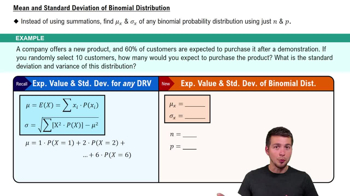
Mean & Standard Deviation of Binomial Distribution

Histogram

A histogram is a graphical representation of the distribution of numerical data, where the data is divided into bins or intervals. Each bin's height reflects the frequency of data points within that interval. In the context of the binomial distribution, the histogram will display the number of patients who survive versus those who do not, illustrating the probabilities of different outcomes.
Recommended video:
Guided course
05:54
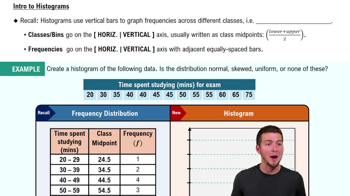
Intro to Histograms

Shape of the Distribution

The shape of a binomial distribution can vary based on the probability of success and the number of trials. When the probability of success is greater than 0.5, the distribution is typically skewed to the right, indicating more successes. In this scenario, with a 75% survival rate and six patients, the histogram is expected to show a right-skewed shape, reflecting a higher likelihood of more patients surviving.
Recommended video:
05:11
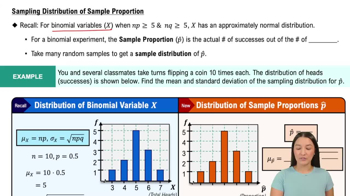
Sampling Distribution of Sample Proportion
Related Practice
Textbook Question

Identifying and Understanding Binomial Experiments In Exercises 15–18, determine whether the experiment is a binomial experiment. If it is, identify a success; specify the values of n, p, and q; and list the possible values of the random variable x. If it is not a binomial experiment, explain why.


Video Games A survey found that 29% of gamers own a virtual reality (VR) device. Ten gamers are randomly selected. The random variable represents the number who own a VR device. (Source: Entertainment Software Association)

111
views
Textbook Question

Identifying and Understanding Binomial Experiments In Exercises 15–18, determine whether the experiment is a binomial experiment. If it is, identify a success; specify the values of n, p, and q; and list the possible values of the random variable x. If it is not a binomial experiment, explain why.


Basketball A’ja Wilson, the 2020 WNBA Most Valuable Player, makes a free throw shot about 78% of the time. The random variable represents the number of free throws that she makes on eight attempts. (Source: Women’s National Basketball Association)

165
views
Textbook Question

In the past year, thirty-three percent of U.S. adults have put off medical treatment because of the cost. You randomly select nine U.S. adults. Find the probability that the number who have put off medical treatment because of the cost in the past year is (a) exactly three, (b) at most four, and (c) more than five. (Source: Gallup)

89
views
Textbook Question

An online magazine finds that the mean number of typographical errors per page is five. Find the probability that the number of typographical errors found on any given page is (a) exactly five, (b) less than five, and (c) exactly zero.

108
views
Textbook Question

The table lists the number of wireless devices per household in a small town in the United States.

c. Find the mean, variance, and standard deviation of the probability distribution and interpret the results.

88
views
Textbook Question

The table lists the number of wireless devices per household in a small town in the United States.

a. Construct a probability distribution.

96
views