Ch. 4 - Discrete Probability Distributions
Larson - Elementary Statistics: Picturing the World 8th Edition
Larson8th EditionElementary Statistics: Picturing the WorldISBN: 9780137493470Not the one you use?Change textbook
Chapter 4, Problem 4.1.23

Unusual Events In Exercise 19, would it be unusual for a household to have no HD televisions? Explain your reasoning.

Verified step by step guidance
1
Identify the statistical context of the problem: Determine whether the event of a household having no HD televisions is considered unusual. This typically involves analyzing probabilities or proportions.
Define the threshold for an unusual event: In statistics, an event is often considered unusual if its probability is less than 0.05 (5%).
Gather the necessary data: Look for the probability or proportion of households that have no HD televisions. This information might be provided in the exercise or can be derived from a given distribution.
Compare the probability to the threshold: If the probability of a household having no HD televisions is less than 0.05, then it is considered unusual. Otherwise, it is not unusual.
Explain the reasoning: Clearly state whether the event is unusual based on the comparison and provide a justification using the probability and the threshold value.

Verified video answer for a similar problem:

This video solution was recommended by our tutors as helpful for the problem above.
Video duration:
1m
Was this helpful?

Key Concepts

Here are the essential concepts you must grasp in order to answer the question correctly.

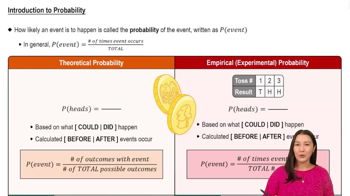
Probability

Probability is a measure of the likelihood that a particular event will occur, expressed as a number between 0 and 1. In the context of households having HD televisions, understanding the probability of a household owning one can help determine if having none is unusual. If the probability of ownership is high, then having no HD televisions would be considered an unusual event.
Recommended video:
5:37
Introduction to Probability

Statistical Significance

Statistical significance refers to the likelihood that a relationship observed in data is not due to random chance. In this scenario, determining whether it is unusual for a household to have no HD televisions involves assessing how many households typically own them. If the proportion of households without HD televisions is significantly lower than expected, it would be deemed unusual.
Recommended video:
Guided course
05:53
Parameters vs. Statistics

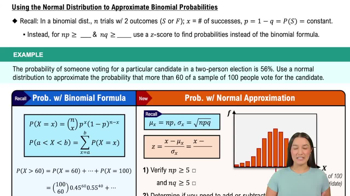
Normal Distribution

Normal distribution is a probability distribution that is symmetric about the mean, indicating that data near the mean are more frequent in occurrence than data far from the mean. In analyzing household ownership of HD televisions, understanding the normal distribution can help identify what constitutes typical versus unusual ownership patterns, allowing for a clearer assessment of whether having no HD televisions is an outlier.
Recommended video:
06:23
Using the Normal Distribution to Approximate Binomial Probabilities
Related Practice
Textbook Question

In Exercises 5–8, find the indicated probability using the Poisson distribution.


P(3) when μ = 6

91
views

Textbook Question

Linear Transformation of a Random Variable In Exercises 41 and 42, use this information about linear transformations. For a random variable x, a new random variable y can be created by applying a linear transformation , where a and b are constants. If the random variable x has mean and standard deviation , then the mean, variance, and standard deviation of y are given by the formulas


The mean annual salary of employees at an office is originally \$46,000. Each employee receives an annual bonus of \$600 and a 3% raise (based on salary). What is the new mean annual salary (including the bonus and raise)?

229
views
Textbook Question

Using a Distribution to Find Probabilities In Exercises 11–26, find the indicated probabilities using the geometric distribution, the Poisson distribution, or the binomial distribution. Then determine whether the events are unusual. If convenient, use a table or technology to find the probabilities.


Pass Completions NFL player Aaron Rodgers completes a pass 65.1% of the time. Find the probability that (a) the first pass he completes is the second pass, (b) the first pass he completes is the first or second pass, and (c) he does not complete his first two passes. (Source: National Football League)

108
views
Textbook Question

Constructing and Graphing Binomial Distributions In Exercises 27–30, (a) construct a binomial distribution, (b) graph the binomial distribution using a histogram and describe its shape, and (c) identify any values of the random variable x that you would consider unusual. Explain your reasoning.


Workplace Cleanliness Fifty-seven percent of employees judge their peers by the cleanliness of their workspaces. You randomly select 10 employees and ask them whether they judge their peers by the cleanliness of their workspaces. The random variable represents the number who judge their peers by the cleanliness of their workspaces. (Source: Adecco)

158
views
Textbook Question

Finding the Mean, Variance, and Standard Deviation In Exercises 29–34, (a) find the mean, variance, and standard deviation of the probability distribution, and (b) interpret the results.

Dogs The number of dogs per household in a neighborhood

251
views
Textbook Question

Discrete Variables and Continuous Variables In Exercises 13–18, determine whether the random variable x is discrete or continuous. Explain.


Let x represent the populations of the 50 U.S. states.

144
views