
Ch. 5 - Normal Probability Distributions
Larson - Elementary Statistics: Picturing the World 8th Edition
Larson8th EditionElementary Statistics: Picturing the WorldISBN: 9780137493470Not the one you use?Change textbook
Chapter 5, Problem 5.4.42

Conservation About 74% of the residents in a town say that they are making an effort to conserve water or electricity. One hundred ten residents are randomly selected. What is the probability that the sample proportion making an effort to conserve water or electricity is greater than 80%? Interpret your result.

Verified step by step guidance
1
Step 1: Identify the given information. The population proportion (p) is 0.74, the sample size (n) is 110, and we are interested in the probability that the sample proportion (p̂) is greater than 0.80.
Step 2: Calculate the mean (μ) and standard deviation (σ) of the sampling distribution of the sample proportion. The mean is equal to the population proportion, μ = p = 0.74. The standard deviation is calculated using the formula: σ = sqrt((p * (1 - p)) / n).
Step 3: Standardize the sample proportion (p̂ = 0.80) to a z-score using the formula: z = (p̂ - μ) / σ. Substitute the values of p̂, μ, and σ into the formula.
Step 4: Use the z-score obtained in Step 3 to find the corresponding probability from the standard normal distribution table. This will give the probability that the sample proportion is less than 0.80.
Step 5: Subtract the probability obtained in Step 4 from 1 to find the probability that the sample proportion is greater than 0.80. Interpret the result in the context of the problem, explaining what it means in terms of the town's residents making an effort to conserve water or electricity.

Verified video answer for a similar problem:

This video solution was recommended by our tutors as helpful for the problem above.
Video duration:
4m
Was this helpful?

Key Concepts

Here are the essential concepts you must grasp in order to answer the question correctly.

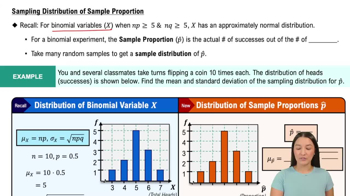
Sample Proportion

The sample proportion is the ratio of individuals in a sample who exhibit a certain characteristic to the total number of individuals in that sample. In this context, it refers to the proportion of residents who are making an effort to conserve water or electricity. Understanding sample proportion is crucial for calculating probabilities related to survey results.
Recommended video:
05:11
Sampling Distribution of Sample Proportion

Normal Approximation to the Binomial Distribution

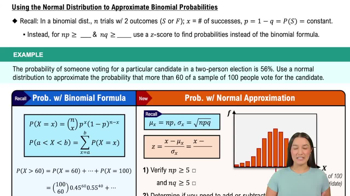
When dealing with large sample sizes, the binomial distribution can be approximated by a normal distribution. This is applicable here since the sample size of 110 is sufficiently large. The normal approximation allows us to use the properties of the normal distribution to calculate probabilities related to the sample proportion.
Recommended video:
06:23
Using the Normal Distribution to Approximate Binomial Probabilities

Hypothesis Testing

Hypothesis testing is a statistical method used to make inferences about a population based on sample data. In this scenario, we would set up a null hypothesis regarding the sample proportion and determine the probability of observing a sample proportion greater than 80%. This process helps in interpreting the significance of the results in the context of the population's conservation efforts.
Recommended video:
Guided course
06:21
Step 1: Write Hypotheses
Related Practice
Textbook Question

In Exercises 39 and 40, determine whether the finite correction factor should be used. If so, use it in your calculations when you find the probability.


Old Faithful In a sample of 100 eruptions of the Old Faithful geyser at Yellowstone National Park, the mean interval between eruptions was 129.58 minutes and the standard deviation was 108.54 minutes. A random sample of size 30 is selected from this population. What is the probability that the mean interval between eruptions is between 120 minutes and 140 minutes?

99
views
Textbook Question

Finding Probability In Exercises 47–56, find the indicated probability using the standard normal distribution. If convenient, use technology to find the probability.


P(z < - 1.11)

75
views
Textbook Question

Interpreting the Central Limit Theorem In Exercises 19–26, find the mean and standard deviation of the indicated sampling distribution of sample means. Then sketch a graph of the sampling distribution.


Renewable Energy The zloty is the official currency of Poland. During a recent period of two years, the day-ahead prices for renewable energy in Poland (in zlotys per mega-watt hour) have a mean of 158.51 and a standard deviation of 33.424. Random samples of size 100 are drawn from this population, and the mean of each sample is determined. (Adapted from Multidisciplinary Digital Publishing Institute)

105
views
Textbook Question

Computing Probabilities for Normal Distributions In Exercises 1–6, the random variable x is normally distributed with mean mu=174 and standard deviation sigma=20. Find the indicated probability.


P(x > 182)

108
views
Textbook Question

In Exercises 9–14, write the binomial probability in words. Then, use a continuity correction to convert the binomial probability to a normal distribution probability.


P(55 < x < 60)

191
views
Textbook Question

True or False? In Exercises 5–8, determine whether the statement is true or false. If it is false, rewrite it as a true statement.


As the sample size increases, the standard deviation of the distribution of sample means increases.

83
views