
Ch. 5 - Normal Probability Distributions
Larson - Elementary Statistics: Picturing the World 8th Edition
Larson8th EditionElementary Statistics: Picturing the WorldISBN: 9780137493470Not the one you use?Change textbook
Chapter 5, Problem 5.1.26

Finding Area
In Exercises 23–36, find the indicated area under the standard normal curve. If convenient, use technology to find the area.


To the left of z=1.365

Verified step by step guidance
1
Step 1: Understand the problem. The goal is to find the area under the standard normal curve to the left of z = 1.365. This area represents the cumulative probability for a standard normal distribution up to the z-score of 1.365.
Step 2: Recall that the standard normal distribution is symmetric about the mean (z = 0) and has a total area of 1 under the curve. The cumulative area to the left of a given z-score can be found using a z-table, statistical software, or a calculator with normal distribution functions.
Step 3: Use the z-table or technology. Locate the z-score of 1.365 in the z-table. The table provides the cumulative probability (area) to the left of the given z-score. If using technology, input the z-score into the cumulative distribution function (CDF) for the standard normal distribution.
Step 4: Interpret the result. The value obtained from the z-table or technology represents the proportion of the data that falls to the left of z = 1.365 in a standard normal distribution.
Step 5: If using technology, verify the input. For example, in a calculator or software, use the function for the cumulative probability of a standard normal distribution, such as P(Z ≤ 1.365), to ensure accuracy.

Verified video answer for a similar problem:

This video solution was recommended by our tutors as helpful for the problem above.
Video duration:
2m
Was this helpful?

Key Concepts

Here are the essential concepts you must grasp in order to answer the question correctly.

Standard Normal Distribution

The standard normal distribution is a special normal distribution with a mean of 0 and a standard deviation of 1. It is represented by the variable 'z', which indicates how many standard deviations an element is from the mean. This distribution is crucial for calculating probabilities and areas under the curve, as it allows for the standardization of different normal distributions.
Recommended video:
Guided course
09:47
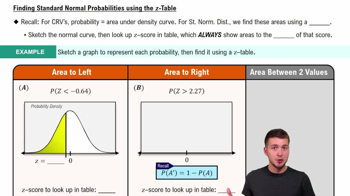
Finding Standard Normal Probabilities using z-Table

Z-Score

A z-score is a statistical measurement that describes a value's relationship to the mean of a group of values. It is calculated by subtracting the mean from the value and then dividing by the standard deviation. In the context of the standard normal distribution, the z-score helps determine the area under the curve to the left of a specific value, which corresponds to the probability of a random variable being less than that value.
Recommended video:
Guided course
06:31
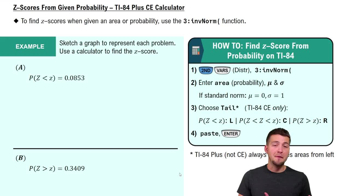
Z-Scores From Given Probability - TI-84 (CE) Calculator

Area Under the Curve

The area under the curve (AUC) in a probability distribution represents the likelihood of a random variable falling within a certain range. For the standard normal distribution, this area can be found using z-scores and standard normal tables or technology. The area to the left of a given z-score indicates the cumulative probability up to that point, which is essential for statistical inference and hypothesis testing.
Recommended video:
Guided course
08:50
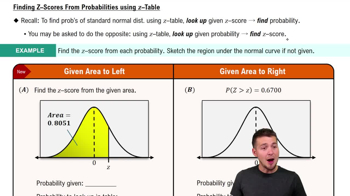
Z-Scores from Probabilities
Related Practice
Textbook Question

Paint Cans A machine is set to fill paint cans with a mean of 128 ounces and a standard deviation of 0.2 ounce. A random sample of 40 cans has a mean of 127.9 ounces. The machine needs to be reset when the mean of a random sample is unusual. Does the machine need to be reset? Explain.

71
views
Textbook Question

Approximating a Binomial Distribution In Exercises 17 and 18, a binomial experiment is given. Determine whether you can use a normal distribution to approximate the binomial distribution. If you can, find the mean and standard deviation. If you cannot, explain why.


Bachelor’s Degrees Twenty-two percent of adults over 18 years of age have a bachelor’s degree. You randomly select 20 adults over 18 years of age and ask whether they have a bachelor’s degree.

132
views
Textbook Question

Finding a z-Score Given an Area In Exercises 23–30, find the indicated z-score.


Find the z-score that has 78.5% of the distribution’s area to its left.

111
views
Textbook Question

Bags of Baby Carrots The weights of bags of baby carrots are normally distributed, with a mean of 32 ounces and a standard deviation of 0.36 ounce. Bags in the upper 4.5% are too heavy and must be repackaged. What is the most a bag of baby carrots can weigh and not need to be repackaged?

103
views
Textbook Question

Finding Probability In Exercises 47–56, find the indicated probability using the standard normal distribution. If convenient, use technology to find the probability.


P(z < - 1.11)

75
views
Textbook Question

True or False? In Exercises 5–8, determine whether the statement is true or false. If it is false, rewrite it as a true statement.


As the sample size increases, the standard deviation of the distribution of sample means increases.

83
views