Ch. 5 - Normal Probability Distributions
Larson - Elementary Statistics: Picturing the World 8th Edition
Larson8th EditionElementary Statistics: Picturing the WorldISBN: 9780137493470Not the one you use?Change textbook
Chapter 5, Problem 5.5.29

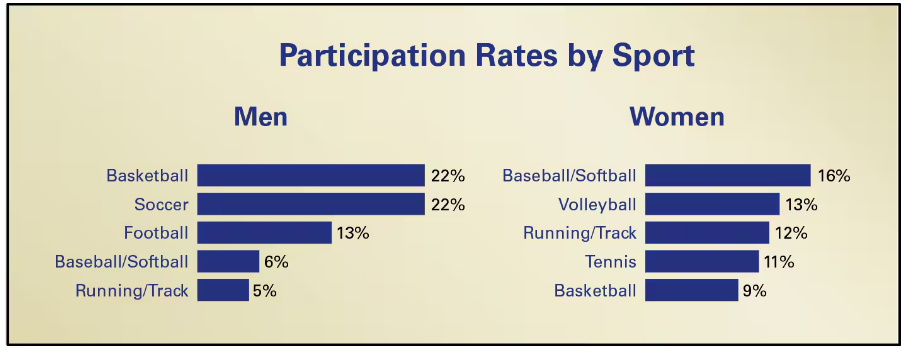
"Getting Physical The figure shows the results of a survey of U.S. adults ages 18 to 29 who were asked whether they participated in a sport. In the survey, 48% of the men and 23% of the women said they participate in sports. The most common sports are shown below. Use this information in Exercises 29 and 30.

You randomly select 250 U.S. men ages 18 to 29 and ask them whether they participate in at least one sport. You find that 80% say no. How likely is this result? Do you think this sample is a good one? Explain your reasoning."

Verified step by step guidance
1
Step 1: Identify the given data from the problem. The survey states that 48% of men ages 18 to 29 participate in sports, and you randomly select 250 men in this age group. Out of these, 80% say they do not participate in sports, meaning only 20% say they do. This is significantly lower than the expected 48%.
Step 2: Calculate the expected number of men who participate in sports based on the survey data. Multiply the total sample size (250 men) by the participation rate (48%). Use the formula: Expected=Sample×Participation%.
Step 3: Compare the observed number of men who participate in sports (20% of 250 men) to the expected number calculated in Step 2. This will help determine if the observed result is significantly different from the expected result.
Step 4: Use a statistical test, such as a z-test for proportions, to assess the likelihood of observing such a result. The formula for the z-score is: z=(Observed-Expected)Standard Error. Calculate the standard error using the formula: SE=p(1-p)n, where p is the expected proportion and n is the sample size.
Step 5: Interpret the z-score and p-value obtained from the statistical test. If the p-value is very small (typically less than 0.05), the observed result is unlikely under the assumption that the survey data is accurate. Discuss whether the sample is representative and whether factors such as sampling bias or survey methodology could explain the discrepancy.

Verified video answer for a similar problem:

This video solution was recommended by our tutors as helpful for the problem above.
Video duration:
4m
Was this helpful?

Key Concepts

Here are the essential concepts you must grasp in order to answer the question correctly.

Sampling and Sample Size

Sampling refers to the process of selecting a subset of individuals from a population to estimate characteristics of the whole group. The sample size, in this case, 250 U.S. men ages 18 to 29, is crucial as larger samples tend to provide more reliable estimates of population parameters. However, the representativeness of the sample is equally important; if the sample is biased, the results may not accurately reflect the population.
Recommended video:
05:11
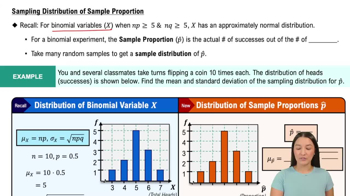
Sampling Distribution of Sample Proportion

Statistical Significance

Statistical significance helps determine whether the results observed in a sample are likely due to chance or reflect true differences in the population. In this context, finding that 80% of the sampled men say they do not participate in sports is a significant deviation from the expected participation rate of 48%. Analyzing this discrepancy can help assess the validity of the sample and the likelihood of such a result occurring by random chance.
Recommended video:
Guided course
05:53
Parameters vs. Statistics

Participation Rates

Participation rates indicate the proportion of individuals in a specific group who engage in a particular activity, such as sports. The survey shows that 48% of men and 23% of women participate in sports, which sets a baseline for comparison. Understanding these rates is essential for evaluating the sample's findings and determining whether the observed 80% non-participation rate is an anomaly or indicative of a broader trend.
Recommended video:
03:39
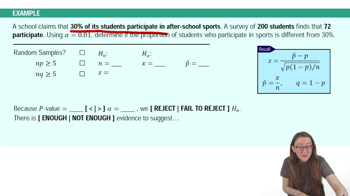
Performing Hypothesis Tests: Proportions Example 2