
Ch. 5 - Normal Probability Distributions
Larson - Elementary Statistics: Picturing the World 8th Edition
Larson8th EditionElementary Statistics: Picturing the WorldISBN: 9780137493470Not the one you use?Change textbook
Chapter 5, Problem 5.3.42e

History Grades In a history class, the grades for various assessments are all positive numbers and have different distributions. Determine whether the grades for each assessment could be normally distributed. Explain your reasoning.


e. an extra credit assignment with a mean of 2.25 and a standard deviation of 2.49

Verified step by step guidance
1
Understand the concept of normal distribution: A normal distribution is a symmetric, bell-shaped curve where most of the data points cluster around the mean, and the probabilities taper off equally on both sides. It is characterized by two parameters: the mean (μ) and the standard deviation (σ).
Examine the given data: The extra credit assignment has a mean (μ) of 2.25 and a standard deviation (σ) of 2.49. Note that the standard deviation is larger than the mean, which suggests that the data might be highly spread out or skewed.
Consider the shape of the data: For a dataset to be normally distributed, it should not have extreme skewness or outliers. A standard deviation larger than the mean could indicate a potential skewness or a non-normal distribution. This is because a normal distribution typically has most of its data concentrated near the mean, and such a large spread might not align with this property.
Analyze the context: Grades for an extra credit assignment are often not normally distributed because they may be clustered near specific values (e.g., many students scoring zero if they did not attempt the assignment) or have a long tail (e.g., a few students scoring very high). This would result in a distribution that is not symmetric or bell-shaped.
Conclude and verify: To confirm whether the grades are normally distributed, you could use statistical tests such as the Shapiro-Wilk test or the Kolmogorov-Smirnov test, or visually inspect the data using a histogram or Q-Q plot. However, based on the given information, it is unlikely that the grades for this extra credit assignment follow a normal distribution.

Verified video answer for a similar problem:

This video solution was recommended by our tutors as helpful for the problem above.
Video duration:
2m
Was this helpful?

Key Concepts

Here are the essential concepts you must grasp in order to answer the question correctly.

Normal Distribution

Normal distribution is a probability distribution that is symmetric about the mean, showing that data near the mean are more frequent in occurrence than data far from the mean. It is characterized by its bell-shaped curve, defined by its mean and standard deviation. In a normal distribution, approximately 68% of the data falls within one standard deviation of the mean, which is crucial for understanding how grades might be distributed.
Recommended video:
06:23
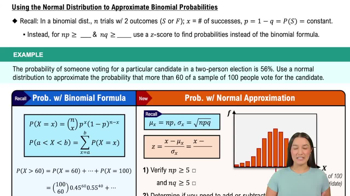
Using the Normal Distribution to Approximate Binomial Probabilities

Mean and Standard Deviation

The mean is the average of a set of values, while the standard deviation measures the amount of variation or dispersion in a set of values. A low standard deviation indicates that the values tend to be close to the mean, whereas a high standard deviation indicates that the values are spread out over a wider range. In the context of grades, these statistics help assess whether the distribution of grades aligns with the characteristics of a normal distribution.
Recommended video:
Guided course
08:45
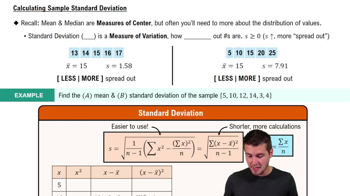
Calculating Standard Deviation

Assessment Distribution

Assessment distribution refers to how grades are spread across different assessments. Each assessment can have its own distribution shape, which may or may not resemble a normal distribution. Understanding the distribution of grades is essential for determining if they could be normally distributed, as factors like skewness and kurtosis can indicate deviations from normality, impacting the interpretation of the mean and standard deviation.
Recommended video:
Guided course
06:38
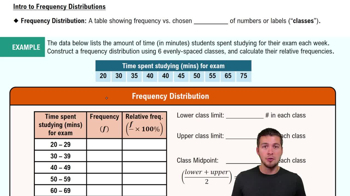
Intro to Frequency Distributions
Related Practice
Textbook Question

Finding Probabilities for Normal Distributions In Exercises 7–12, find the indicated probabilities. If convenient, use technology to find the probabilities.


Health Club Schedule The amounts of time per workout an athlete uses a stairclimber are normally distributed, with a mean of 20 minutes and a standard deviation of 5 minutes. Find the probability that a randomly selected athlete uses a stairclimber for (c) more than 30 minutes.

109
views
Textbook Question

Uniform Distribution A uniform distribution is a continuous probability distribution for a random variable x between two values a and b (a<b), where (a ≤ x ≤ b) and all of the values of x are equally likely to occur. The graph of a uniform distribution is shown below.

The probability density function of a uniform distribution is


on the interval from (x=a) to (x=b). For any value of x less than a or greater than b, y=0 . In Exercises 59 and 60, use this information.


For two values c and d, where a ≤ c < d ≤ b, the probability that x lies between c and d is equal to the area under the curve between c and d, as shown below.


So, the area of the red region equals the probability that x lies between c and d. For a uniform distribution from (a=1) to (b=25) , find the probability that


d. x lies between 8 and 14.

248
views
Textbook Question

Finding Probabilities for Normal Distributions In Exercises 7–12, find the indicated probabilities. If convenient, use technology to find the probabilities.


MCAT Scores In a recent year, the MCAT total scores were normally distributed, with a mean of 500.9 and a standard deviation of 10.6. Find the probability that a randomly selected medical student who took the MCAT has a total score that is (c) more than 515. Identify any unusual events in parts (a)–(c). Explain your reasoning. (Source: Association of American Medical Colleges)

78
views