

Ch. 5 - Normal Probability Distributions
Larson - Elementary Statistics: Picturing the World 8th Edition
Larson8th EditionElementary Statistics: Picturing the WorldISBN: 9780137493470Not the one you use?Change textbook
Chapter 5, Problem 5.5.3

In Exercises 1–4, the sample size n, probability of success p, and probability of failure q are given for a binomial experiment. Determine whether you can use a normal distribution to approximate the distribution of x.
n=18, p=0.90, q=0.10

Verified step by step guidance
1
Step 1: Recall the rule for using a normal distribution to approximate a binomial distribution. The approximation is valid if both np ≥ 5 and nq ≥ 5, where n is the sample size, p is the probability of success, and q is the probability of failure.
Step 2: Calculate np by multiplying the sample size n by the probability of success p. Use the formula: np = n × p.
Step 3: Calculate nq by multiplying the sample size n by the probability of failure q. Use the formula: nq = n × q.
Step 4: Check whether both conditions np ≥ 5 and nq ≥ 5 are satisfied. If both conditions are met, the normal approximation can be used; otherwise, it cannot.
Step 5: Conclude whether the normal distribution can approximate the binomial distribution based on the results of the calculations in Steps 2 and 3.

Verified video answer for a similar problem:

This video solution was recommended by our tutors as helpful for the problem above.
Video duration:
2m
Was this helpful?

Key Concepts

Here are the essential concepts you must grasp in order to answer the question correctly.

Binomial Distribution

A binomial distribution models the number of successes in a fixed number of independent Bernoulli trials, each with the same probability of success. It is characterized by two parameters: the number of trials (n) and the probability of success (p). In this case, with n=18 and p=0.90, we can analyze the likelihood of achieving a certain number of successes in these trials.
Recommended video:
Guided course
03:28
Mean & Standard Deviation of Binomial Distribution

Normal Approximation

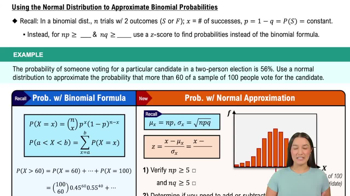
The normal approximation to the binomial distribution is used when certain conditions are met, specifically when both np and nq are greater than or equal to 5. This allows us to use the normal distribution to estimate probabilities for binomial experiments, simplifying calculations. In this scenario, we need to check if np and nq meet this criterion to determine if the normal approximation is valid.
Recommended video:
06:23
Using the Normal Distribution to Approximate Binomial Probabilities

Conditions for Normal Approximation

To use the normal approximation for a binomial distribution, the conditions np ≥ 5 and nq ≥ 5 must be satisfied. Here, np = 18 * 0.90 = 16.2 and nq = 18 * 0.10 = 1.8. Since nq is less than 5, the normal approximation is not appropriate for this binomial experiment, indicating that we should rely on the binomial distribution for accurate probability calculations.
Recommended video:
06:23
Using the Normal Distribution to Approximate Binomial Probabilities
Related Practice
Textbook Question

In Exercises 21–24, a control chart is shown. Each chart has horizontal lines drawn at the mean mu, at mu ±2sigma, and at mu±3sigma. Determine whether the process shown is in control or out of control. Explain.


A gear has been designed to have a diameter of 3 inches. The standard deviation of the process is 0.2 inch.


100
views
Textbook Question

Finding Probabilities for Sampling Distributions In Exercises 29–32, find the indicated probability and interpret the results.


Dow Jones Industrial Average From 1975 through 2020, the mean annual gain of the Dow Jones Industrial Average was 652. A random sample of 32 years is selected from this population. What is the probability that the mean gain for the sample was between 400 and 700? Assume sigma=1540

87
views
Textbook Question

"Getting Physical The figure shows the results of a survey of U.S. adults ages 18 to 29 who were asked whether they participated in a sport. In the survey, 48% of the men and 23% of the women said they participate in sports. The most common sports are shown below. Use this information in Exercises 29 and 30.


You randomly select 300 U.S. women ages 18 to 29 and ask them whether they participate in at least one sport. Of the 72 who say yes, 50% say they participate in volleyball. How likely is this result? Do you think this sample is a good one? Explain your reasoning."

44
views
Textbook Question

Paint Cans A machine is set to fill paint cans with a mean of 128 ounces and a standard deviation of 0.2 ounce. A random sample of 40 cans has a mean of 127.9 ounces. The machine needs to be reset when the mean of a random sample is unusual. Does the machine need to be reset? Explain.

71
views
Textbook Question

Approximating a Binomial Distribution In Exercises 17 and 18, a binomial experiment is given. Determine whether you can use a normal distribution to approximate the binomial distribution. If you can, find the mean and standard deviation. If you cannot, explain why.


Bachelor’s Degrees Twenty-two percent of adults over 18 years of age have a bachelor’s degree. You randomly select 20 adults over 18 years of age and ask whether they have a bachelor’s degree.

132
views
Textbook Question

Finding a z-Score Given an Area In Exercises 23–30, find the indicated z-score.


Find the z-score that has 78.5% of the distribution’s area to its left.

111
views