

Ch. 5 - Normal Probability Distributions
Larson - Elementary Statistics: Picturing the World 8th Edition
Larson8th EditionElementary Statistics: Picturing the WorldISBN: 9780137493470Not the one you use?Change textbook
Chapter 5, Problem 5.5.31

Testing a Drug A drug manufacturer claims that a drug cures a rare skin disease 75% of the time. The claim is checked by testing the drug on 100 patients. If at least 70 patients are cured, then this claim will be accepted. Use this information in Exercises 31 and 32.


Find the probability that the claim will be rejected, assuming that the manufacturer’s claim is true.

Verified step by step guidance
1
Step 1: Identify the type of probability distribution involved. Since the problem involves a fixed number of trials (100 patients), each with two possible outcomes (cured or not cured), and the probability of success (cure) is constant at 75%, this is a binomial distribution. The binomial distribution is defined as P(X = k) = (n choose k) * p^k * (1-p)^(n-k), where n is the number of trials, k is the number of successes, and p is the probability of success.
Step 2: Define the random variable and parameters. Let X represent the number of patients cured. Here, X follows a binomial distribution with n = 100 and p = 0.75. The claim will be rejected if fewer than 70 patients are cured, so we need to calculate P(X < 70).
Step 3: Express the probability to be calculated. The probability that the claim will be rejected is P(X < 70), which can be written as the sum of probabilities for all values of X from 0 to 69: P(X < 70) = P(X = 0) + P(X = 1) + ... + P(X = 69).
Step 4: Use a cumulative probability function or statistical software. Calculating P(X < 70) manually for a binomial distribution with n = 100 is computationally intensive. Instead, use a cumulative distribution function (CDF) for the binomial distribution, which is often available in statistical software or calculators. For example, in Python, you can use the 'binom.cdf' function from the scipy.stats library.
Step 5: Interpret the result. Once P(X < 70) is calculated using the CDF, this value represents the probability that fewer than 70 patients are cured, leading to the rejection of the manufacturer's claim. Ensure the interpretation aligns with the context of the problem.

Verified video answer for a similar problem:

This video solution was recommended by our tutors as helpful for the problem above.
Video duration:
4m
Was this helpful?

Key Concepts

Here are the essential concepts you must grasp in order to answer the question correctly.

Binomial Distribution

The binomial distribution models the number of successes in a fixed number of independent Bernoulli trials, each with the same probability of success. In this scenario, the drug's effectiveness can be treated as a series of trials where each patient either gets cured (success) or does not (failure). The parameters for this distribution are the number of trials (100 patients) and the probability of success (0.75).
Recommended video:
Guided course
03:28
Mean & Standard Deviation of Binomial Distribution

Hypothesis Testing

Hypothesis testing is a statistical method used to make decisions about a population based on sample data. In this case, the null hypothesis would state that the drug cures 75% of patients, while the alternative hypothesis would suggest that it does not. The decision to accept or reject the manufacturer's claim is based on the results of the tests conducted on the 100 patients.
Recommended video:
Guided course
06:21
Step 1: Write Hypotheses

Critical Value and Rejection Region

The critical value is a threshold that determines the boundary for rejecting the null hypothesis. In this scenario, the claim will be rejected if fewer than 70 patients are cured. This creates a rejection region in the context of the binomial distribution, where the probability of observing fewer than 70 successes can be calculated to assess the likelihood of rejecting the claim.
Recommended video:
05:50
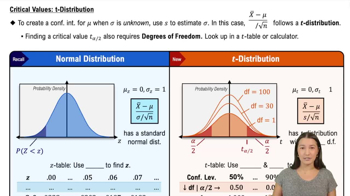
Critical Values: t-Distribution
Related Practice
Textbook Question

In Exercises 39 and 40, determine whether the finite correction factor should be used. If so, use it in your calculations when you find the probability.


Old Faithful In a sample of 100 eruptions of the Old Faithful geyser at Yellowstone National Park, the mean interval between eruptions was 129.58 minutes and the standard deviation was 108.54 minutes. A random sample of size 30 is selected from this population. What is the probability that the mean interval between eruptions is between 120 minutes and 140 minutes?

99
views
Textbook Question

Computing Probabilities for Normal Distributions In Exercises 1–6, the random variable x is normally distributed with mean mu=174 and standard deviation sigma=20. Find the indicated probability.


P(x > 182)

108
views
Textbook Question

In Exercises 9–14, write the binomial probability in words. Then, use a continuity correction to convert the binomial probability to a normal distribution probability.


P(55 < x < 60)

191
views
Textbook Question

In Exercises 5–8, match the binomial probability statement with its corresponding normal distribution probability statement (a)–(d) after a continuity correction.

P(x<109)


a. P(x>109.5)

b. P(x<108.5)

c. P(x<109.5)

d. P(x>108.5)

156
views
Textbook Question

Finding Probability In Exercises 41–46, find the probability of z occurring in the shaded region of the standard normal distribution. If convenient, use technology to find the probability.


137
views
Textbook Question

Finding Area

In Exercises 23–36, find the indicated area under the standard normal curve. If convenient, use technology to find the area.


To the right of z= -0.355

85
views