Ch. 6 - Confidence Intervals
Larson - Elementary Statistics: Picturing the World 8th Edition
Larson8th EditionElementary Statistics: Picturing the WorldISBN: 9780137493470Not the one you use?Change textbook
Chapter 6, Problem 6.3.20b

Alcohol-Impaired Driving You wish to estimate, with 95% confidence, the population proportion of motor vehicle fatalities that were caused by alcohol-impaired driving. Your estimate must be accurate within 5% of the population proportion.
b. Find the minimum sample size needed, using a prior study that found that 28% of motor vehicle fatalities were caused by alcohol-impaired driving. (Source: National Highway Traffic Safety Administration)

Verified step by step guidance
1
Step 1: Identify the formula for determining the minimum sample size for estimating a population proportion. The formula is: n = (Z^2 * p * (1 - p)) / E^2, where n is the sample size, Z is the z-score corresponding to the desired confidence level, p is the estimated population proportion, and E is the margin of error.
Step 2: Determine the values for the variables in the formula. For a 95% confidence level, the z-score (Z) is approximately 1.96. The estimated population proportion (p) is 0.28, based on the prior study. The margin of error (E) is 0.05, as the estimate must be accurate within 5%.
Step 3: Substitute the values into the formula. Replace Z with 1.96, p with 0.28, and E with 0.05 in the equation: n = (1.96^2 * 0.28 * (1 - 0.28)) / 0.05^2.
Step 4: Simplify the numerator of the formula. Calculate 1.96^2, then multiply it by 0.28 and by (1 - 0.28), which is 0.72.
Step 5: Simplify the denominator of the formula. Calculate 0.05^2, then divide the simplified numerator by this value to find the minimum sample size n. Round up to the nearest whole number, as sample size must be an integer.

Verified video answer for a similar problem:

This video solution was recommended by our tutors as helpful for the problem above.
Video duration:
2m
Was this helpful?

Key Concepts

Here are the essential concepts you must grasp in order to answer the question correctly.

Population Proportion

The population proportion refers to the fraction of a population that exhibits a certain characteristic, in this case, the proportion of motor vehicle fatalities caused by alcohol-impaired driving. It is denoted as 'p' and is crucial for estimating the sample size needed to achieve a desired level of confidence in statistical studies.
Recommended video:
05:45
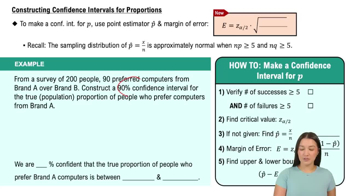
Constructing Confidence Intervals for Proportions

Sample Size Calculation

Sample size calculation is a statistical method used to determine the number of observations or replicates needed to ensure that the results of a study are statistically valid. In this context, it involves using the desired margin of error (5%) and the confidence level (95%) to calculate how many samples are necessary to accurately estimate the population proportion.
Recommended video:
05:11
Sampling Distribution of Sample Proportion

Confidence Interval

A confidence interval is a range of values, derived from sample statistics, that is likely to contain the population parameter with a specified level of confidence. For this question, a 95% confidence interval means that if the study were repeated multiple times, 95% of the calculated intervals would contain the true population proportion of alcohol-impaired driving fatalities.
Recommended video:
06:33
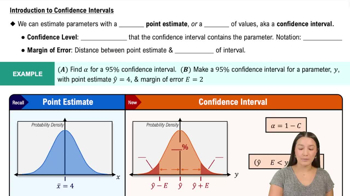
Introduction to Confidence Intervals
Related Practice
Textbook Question

When all other quantities remain the same, how does the indicated change affect the minimum sample size requirement? Explain.

b. Increase in the error tolerance

83
views

Textbook Question

Constructing Confidence Intervals In Exercises 13–24, assume the sample is from a normally distributed population and construct the indicated confidence intervals for (b) the population standard deviation σ. Interpret the results.

Drug Concentration The times (in minutes) for the drug concentration to peak when the drug epinephrine is injected into 15 randomly selected patients are listed. Use a 90% level of confidence.

56
views
Textbook Question

Constructing Confidence Intervals In Exercises 13–24, assume the sample is from a normally distributed population and construct the indicated confidence intervals for (b) the population standard deviation σ. Interpret the results.

[APPLET] Earnings The annual earnings (in thousands of dollars) of 21 randomly selected level 1 computer hardware engineers are listed. Use a 99% level of confidence. (Adapted from Salary.com)

100
views
Textbook Question

Congress You wish to estimate, with 95% confidence, the population proportion of likely U.S. voters who think Congress is doing a good or excellent job. Your estimate must be accurate within 4% of the population proportion.

b. Find the minimum sample size needed, using a prior survey that found that 21% of likely U.S. voters think Congress is doing a good or excellent job. (Source: Rasmussen Reports)

91
views
Textbook Question

Constructing Confidence Intervals In Exercises 13–24, assume the sample is from a normally distributed population and construct the indicated confidence intervals for (b) the population standard deviation σ. Interpret the results.

Annual Precipitation The annual precipitation amounts (in inches) of a random sample of 61 years for Chicago, Illinois, have a sample standard deviation of 6.46. Use a 98% level of confidence. (Source: National Oceanic and Atmospheric Administration)

60
views
Textbook Question

Constructing Confidence Intervals In Exercises 13–24, assume the sample is from a normally distributed population and construct the indicated confidence intervals for (a) the population variance σ^2. Interpret the results.

Volleyball The numbers of service aces scored by 15 teams randomly selected from the top 50 NCAA Division I Women’s Volleyball teams for the 2021 season have a sample standard deviation of 26.1. Use an 80% level of confidence. (Source: National Collegiate Athletic Association)

65
views