
Ch. 6 - Confidence Intervals
Larson - Elementary Statistics: Picturing the World 8th Edition
Larson8th EditionElementary Statistics: Picturing the WorldISBN: 9780137493470Not the one you use?Change textbook
Chapter 6, Problem 6.4.15a

Constructing Confidence Intervals In Exercises 13–24, assume the sample is from a normally distributed population and construct the indicated confidence intervals for (a) the population variance σ^2. Interpret the results.
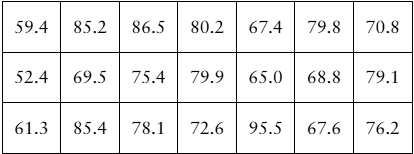
[APPLET] Earnings The annual earnings (in thousands of dollars) of 21 randomly selected level 1 computer hardware engineers are listed. Use a 99% level of confidence. (Adapted from Salary.com)
Table displaying annual earnings (in thousands) of 21 computer hardware engineers, with values ranging from 52.4 to 95.5.

Verified step by step guidance
1
Step 1: Calculate the sample variance (s^2). First, compute the sample mean (x̄) by summing all the earnings values and dividing by the sample size (n = 21). Then, use the formula for variance: s^2 = (Σ(xi - x̄)^2) / (n - 1), where xi represents each individual data point.
Step 2: Identify the degrees of freedom (df). For this problem, df = n - 1, where n is the sample size. Since n = 21, df = 20.
Step 3: Use the chi-square distribution to find the critical values for the 99% confidence interval. The chi-square critical values are determined using the chi-square table or a statistical calculator for df = 20 and the desired confidence level (99%). The lower critical value corresponds to α/2, and the upper critical value corresponds to 1 - α/2, where α = 0.01.
Step 4: Construct the confidence interval for the population variance (σ^2) using the formula: [(df * s^2) / χ²_upper, (df * s^2) / χ²_lower], where χ²_upper and χ²_lower are the chi-square critical values.
Step 5: Interpret the results. The confidence interval provides a range of values within which the true population variance is likely to fall with 99% confidence. This interval reflects the variability in annual earnings for level 1 computer hardware engineers.

Verified video answer for a similar problem:

This video solution was recommended by our tutors as helpful for the problem above.
Video duration:
3m
Was this helpful?

Key Concepts

Here are the essential concepts you must grasp in order to answer the question correctly.

Confidence Interval

A confidence interval is a range of values, derived from sample statistics, that is likely to contain the true population parameter with a specified level of confidence. For example, a 99% confidence interval suggests that if we were to take many samples and construct intervals in the same way, approximately 99% of those intervals would contain the true population parameter.
Recommended video:
06:33
Introduction to Confidence Intervals

Population Variance

Population variance is a measure of the dispersion of a set of values in a population, indicating how much the values deviate from the population mean. It is denoted by σ² and is calculated as the average of the squared differences from the mean. Understanding population variance is crucial for constructing confidence intervals for variance.
Recommended video:
04:48
Population Standard Deviation Known

Normal Distribution

Normal distribution is a probability distribution that is symmetric about the mean, showing that data near the mean are more frequent in occurrence than data far from the mean. Many statistical methods, including confidence interval calculations, assume that the underlying data follows a normal distribution, especially when sample sizes are small.
Recommended video:
06:23
Using the Normal Distribution to Approximate Binomial Probabilities
Related Practice
Textbook Question

Constructing Confidence Intervals In Exercises 13–24, assume the sample is from a normally distributed population and construct the indicated confidence intervals for (a) the population variance σ^2. Interpret the results.

Volleyball The numbers of service aces scored by 15 teams randomly selected from the top 50 NCAA Division I Women’s Volleyball teams for the 2021 season have a sample standard deviation of 26.1. Use an 80% level of confidence. (Source: National Collegiate Athletic Association)

59
views
Textbook Question

Fast Food You wish to estimate, with 90% confidence, the population proportion of U.S. families who eat fast food at least once per week. Your estimate must be accurate within 3% of the population proportion.

a. No preliminary estimate is available. Find the minimum sample size needed.

72
views
Textbook Question

Soccer Balls A soccer ball manufacturer wants to estimate the mean circumference of soccer balls within 0.15 inch.

a. Determine the minimum sample size required to construct a 99% confidence interval for the population mean. Assume the population standard deviation is 0.5 inch

68
views
Textbook Question

Constructing a Confidence Interval In Exercises 31 and 32, use the data set to (a) find the sample mean

[APPLET] Earnings The annual earnings (in dollars) of 32 randomly selected intermediate level life insurance underwriters (Adapted from Salary.com)

79
views
Textbook Question

Constructing a Confidence Interval In Exercises 25–28, use the data set to (a) find the sample mean. Assume the population is normally distributed.

SAT Scores The SAT scores of 12 randomly selected high school seniors

95
views
Textbook Question

Ages of College Students An admissions director wants to estimate the mean age of all students enrolled at a college. The estimate must be within 1.5 years of the population mean. Assume the population of ages is normally distributed.

a. Determine the minimum sample size required to construct a 90% confidence interval for the population mean. Assume the population standard deviation is 1.6 years.

102
views