
Ch. 6 - Confidence Intervals
Larson - Elementary Statistics: Picturing the World 8th Edition
Larson8th EditionElementary Statistics: Picturing the WorldISBN: 9780137493470Not the one you use?Change textbook
Chapter 6, Problem 6.4.22a

Constructing Confidence Intervals In Exercises 13–24, assume the sample is from a normally distributed population and construct the indicated confidence intervals for (a) the population variance σ^2. Interpret the results.
Annual Precipitation The annual precipitation amounts (in inches) of a random sample of 61 years for Chicago, Illinois, have a sample standard deviation of 6.46. Use a 98% level of confidence. (Source: National Oceanic and Atmospheric Administration)

Verified step by step guidance
1
Step 1: Understand the problem. We are tasked with constructing a confidence interval for the population variance (σ²) using the sample standard deviation (s = 6.46), the sample size (n = 61), and a 98% confidence level. The population is assumed to be normally distributed.
Step 2: Recall the formula for the confidence interval of the population variance. The confidence interval is based on the chi-square distribution and is given by: [ (n-1)s² χ² upper , (n-1)s² χ² lower ] where n is the sample size, s² is the sample variance, and χ² values correspond to the chi-square critical values for the given confidence level.
Step 3: Calculate the sample variance (s²). The sample variance is the square of the sample standard deviation: 6.46 2
Step 4: Determine the degrees of freedom (df) and the chi-square critical values. The degrees of freedom are calculated as: df = n - 1 For a 98% confidence level, find the chi-square critical values (χ² lower and χ² upper) using a chi-square table or statistical software.
Step 5: Plug the values into the confidence interval formula. Substitute (n - 1), s², and the chi-square critical values into the formula to compute the lower and upper bounds of the confidence interval for the population variance. Interpret the results by explaining the range within which the true population variance is likely to fall with 98% confidence.

Verified video answer for a similar problem:

This video solution was recommended by our tutors as helpful for the problem above.
Video duration:
4m
Was this helpful?

Key Concepts

Here are the essential concepts you must grasp in order to answer the question correctly.

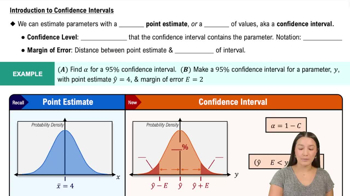
Confidence Interval

A confidence interval is a range of values, derived from sample statistics, that is likely to contain the true population parameter with a specified level of confidence. For example, a 98% confidence interval suggests that if we were to take many samples and construct intervals in the same way, approximately 98% of those intervals would contain the true population parameter.
Recommended video:
06:33
Introduction to Confidence Intervals

Population Variance

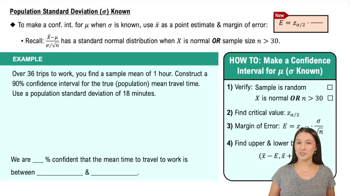
Population variance (σ²) measures the dispersion of a set of values in a population. It is calculated as the average of the squared differences from the mean. In the context of confidence intervals, estimating the population variance helps in understanding the variability of the data and is crucial for constructing accurate intervals.
Recommended video:
04:48
Population Standard Deviation Known

Sample Standard Deviation

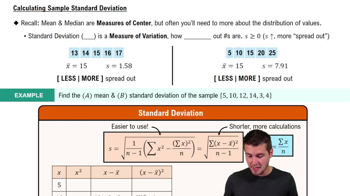
The sample standard deviation is a statistic that quantifies the amount of variation or dispersion in a sample data set. It is calculated as the square root of the sample variance. In this exercise, the sample standard deviation of 6.46 is used to estimate the population variance and to construct the confidence interval for the annual precipitation amounts.
Recommended video:
Guided course
08:45
Calculating Standard Deviation
Related Practice
Textbook Question

Constructing Confidence Intervals In Exercises 13–24, assume the sample is from a normally distributed population and construct the indicated confidence intervals for (a) the population variance σ^2. Interpret the results.

Drive-Thru Times The times (in seconds) spent by a random sample of 28 customers in the drive-thru of a fast-food restaurant have a sample standard deviation of 56.1. Use a 98% level of confidence.

69
views
Textbook Question

Constructing Confidence Intervals In Exercises 13–24, assume the sample is from a normally distributed population and construct the indicated confidence intervals for (a) the population variance σ^2. Interpret the results.

Car Batteries The reserve capacities (in hours) of 18 randomly selected automotive batteries have a sample standard deviation of 0.25 hour. Use an 80% level of confidence.

93
views
Textbook Question

Paint Can Volumes A paint manufacturer uses a machine to fill gallon cans with paint (see figure). The manufacturer wants to estimate the mean volume of paint the machine is putting in the cans within 0.5 ounce. Assume the population of volumes is normally distributed.

a. Determine the minimum sample size required to construct a 90% confidence interval for the population mean. Assume the population standard deviation is 0.75 ounce.

67
views
Textbook Question

Juice Dispensing Machine A beverage company uses a machine to fill half-gallon bottles with fruit juice (see figure). The company wants to estimate the mean volume of water the machine is putting in the bottles within 0.25 fluid ounce.

[IMAGE]

a. Determine the minimum sample size required to construct a 95% confidence interval for the population mean. Assume the population standard deviation is 1 fluid ounce.

66
views
Textbook Question

Cholesterol Contents of Cheese A cheese processing company wants to estimate the mean cholesterol content of all one-ounce servings of a type of cheese. The estimate must be within 0.75 milligram of the population mean.

a. Determine the minimum sample size required to construct a 95% confidence interval for the population mean. Assume the population standard deviation is 3.10 milligrams.

44
views
Textbook Question

Senate Filibuster You wish to estimate, with 99% confidence, the population proportion of U.S. adults who disapprove of the U.S Senate’s use of the filibuster. Your estimate must be accurate within 2% of the population proportion.

a. No preliminary estimate is available. Find the minimum sample size needed.

47
views