Ch. 6 - Confidence Intervals
Larson - Elementary Statistics: Picturing the World 8th Edition
Larson8th EditionElementary Statistics: Picturing the WorldISBN: 9780137493470Not the one you use?Change textbook
Chapter 6, Problem 6.R.19

In Exercises 19–22, let p be the population proportion for the situation. (a) Find point estimates of p and q, (b) construct 90% and 95% confidence intervals for p, and (c) interpret the results of part (b) and compare the widths of the confidence intervals.
In a survey of 912 U.S. adults in Generation Z (born after 1996), 383 said they are at least somewhat likely to consider an electric vehicle for their next vehicle purchase. (Adapted from Pew Research Center)

Verified step by step guidance
1
Step 1: Identify the given values from the problem. The sample size (n) is 912, and the number of successes (x) is 383. The population proportion (p) is estimated as the sample proportion, which is calculated as p̂ = x / n. The complement of p, denoted as q̂, is calculated as q̂ = 1 - p̂.
Step 2: To construct confidence intervals, use the formula for the confidence interval of a population proportion: CI = p̂ ± Z * sqrt((p̂ * q̂) / n). Here, Z is the critical value corresponding to the desired confidence level (e.g., Z = 1.645 for 90% confidence and Z = 1.96 for 95% confidence).
Step 3: Calculate the standard error (SE) for the proportion using the formula SE = sqrt((p̂ * q̂) / n). This value will be used to determine the margin of error for each confidence interval.
Step 4: Compute the margin of error (ME) for each confidence level. For the 90% confidence interval, ME = Z * SE with Z = 1.645. For the 95% confidence interval, ME = Z * SE with Z = 1.96. Add and subtract the margin of error from p̂ to find the lower and upper bounds of each confidence interval.
Step 5: Interpret the results. The confidence intervals provide a range of plausible values for the population proportion (p). Compare the widths of the 90% and 95% confidence intervals. The 95% confidence interval will be wider because it provides a higher level of confidence, requiring a larger margin of error.

Verified video answer for a similar problem:

This video solution was recommended by our tutors as helpful for the problem above.
Video duration:
6m
Was this helpful?

Key Concepts

Here are the essential concepts you must grasp in order to answer the question correctly.

Point Estimate

A point estimate is a single value that serves as an approximation of a population parameter. In this context, the point estimates for the population proportion p (the proportion of Generation Z adults likely to consider an electric vehicle) and q (the proportion not likely to consider one) can be calculated using the sample data. For example, if 383 out of 912 respondents are likely to consider an electric vehicle, the point estimate for p would be 383/912.
Recommended video:
06:33
Introduction to Confidence Intervals

Confidence Interval

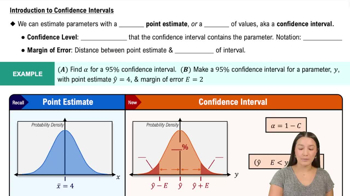
A confidence interval is a range of values, derived from sample statistics, that is likely to contain the true population parameter with a specified level of confidence. For instance, constructing 90% and 95% confidence intervals for p involves calculating the margin of error based on the sample proportion and the standard error. These intervals provide insight into the precision of the estimate and the uncertainty surrounding it.
Recommended video:
06:33
Introduction to Confidence Intervals

Width of Confidence Intervals

The width of a confidence interval reflects the level of uncertainty in the estimate; a wider interval indicates more uncertainty. The width is influenced by the confidence level chosen (e.g., 90% vs. 95%) and the sample size. Generally, higher confidence levels result in wider intervals, as they require a larger margin of error to ensure that the true parameter is captured within the interval.
Recommended video:
06:33
Introduction to Confidence Intervals