Ch. 6 - Confidence Intervals
Larson - Elementary Statistics: Picturing the World 8th Edition
Larson8th EditionElementary Statistics: Picturing the WorldISBN: 9780137493470Not the one you use?Change textbook
Chapter 6, Problem 6.1.28

In Exercises 25–28, use the confidence interval to find the margin of error and the sample mean.
(3.144, 3.176)

Verified step by step guidance
1
Identify the given confidence interval, which is (3.144, 3.176). The lower bound is 3.144, and the upper bound is 3.176.
To find the margin of error (E), use the formula: E = \(\frac{\text{Upper Bound}\) - \(\text{Lower Bound}\)}{2}. Substitute the values of the upper and lower bounds into this formula.
To find the sample mean (\(\bar{x}\)), use the formula: \(\bar{x}\) = \(\frac{\text{Upper Bound}\) + \(\text{Lower Bound}\)}{2}. Substitute the values of the upper and lower bounds into this formula.
Perform the subtraction and division in the margin of error formula to calculate the margin of error.
Perform the addition and division in the sample mean formula to calculate the sample mean.

Verified video answer for a similar problem:

This video solution was recommended by our tutors as helpful for the problem above.
Video duration:
1m
Was this helpful?

Key Concepts

Here are the essential concepts you must grasp in order to answer the question correctly.

Confidence Interval

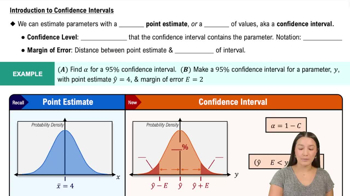
A confidence interval is a range of values, derived from sample statistics, that is likely to contain the true population parameter. It is expressed as an interval (e.g., (3.144, 3.176)) and is associated with a confidence level, indicating the probability that the interval contains the parameter. Understanding confidence intervals is crucial for estimating population parameters and assessing the precision of sample estimates.
Recommended video:
06:33
Introduction to Confidence Intervals

Margin of Error

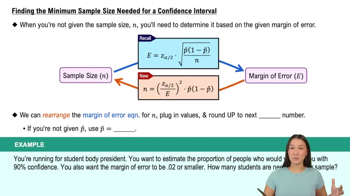
The margin of error quantifies the uncertainty associated with a sample estimate. It is calculated as half the width of the confidence interval, representing the maximum expected difference between the sample statistic and the population parameter. In the given interval (3.144, 3.176), the margin of error would be 0.016, indicating how much the sample mean could vary from the true mean.
Recommended video:
04:08
Finding the Minimum Sample Size Needed for a Confidence Interval

Sample Mean

The sample mean is the average of a set of observations from a sample, serving as a point estimate of the population mean. It is calculated by summing all sample values and dividing by the number of observations. In the context of the confidence interval (3.144, 3.176), the sample mean can be found as the midpoint of the interval, which provides a central value around which the data is distributed.
Recommended video:
05:11
Sampling Distribution of Sample Proportion
Related Practice
Textbook Question

You research prices of cell phones and find that the population mean is \$431.61. In Exercise 19, does the t-value fall between -t0.95 and t0.95?

71
views

Textbook Question

Finding p^ and q^ In Exercises 3–6, let p be the population proportion for the situation. Find point estimates of p and q.

Private Internet Browsing In a survey of 4272 U.S. adults, 1025 knew that private browsing mode only prevents someone using the same computer from seeing one’s online activities. (Adapted from Pew Research Center)

103
views
Textbook Question

In Exercises 35–40, use the standard normal distribution or the t-distribution to construct a 95% confidence interval for the population mean. Justify your decision. If neither distribution can be used, explain why. Interpret the results.

The population standard deviation of the weights of the two-year-old males on a pediatrician’s patient list is 2.49 pounds. The mean weight of a sample of 10 of the two–year–old males is 13.68 pounds. Weights are known to be normally distributed.

85
views
Textbook Question

In Exercise 37, does it seem likely that the population mean could be greater than \$70? Explain.

75
views
Textbook Question

Finding Critical Values for χ2 In Exercises 3–8, find the critical values χR2 and χL2 for the level of confidence c and sample size n.

c = 0.90, n = 8

67
views
Textbook Question

In Exercises 9–12, construct the indicated confidence interval for the population mean μ using the t-distribution. Assume the population is normally distributed.

c = 0.99, xbar = 24.7, s = 4.6, n = 50

70
views