Ch. 6 - Confidence Intervals
Larson - Elementary Statistics: Picturing the World 8th Edition
Larson8th EditionElementary Statistics: Picturing the WorldISBN: 9780137493470Not the one you use?Change textbook
Chapter 6, Problem 6.R.29

In Exercises 27–30, find the critical values and for the level of confidence c and sample size n.
c = 0.90, n = 16

Verified step by step guidance
1
Determine the degrees of freedom (df) for the t-distribution. The formula for degrees of freedom is df = n - 1, where n is the sample size.
Identify the level of confidence (c) and calculate the area in the tails of the t-distribution. For a 90% confidence level, the area in the tails is 1 - c = 0.10, and since the t-distribution is symmetric, divide this area equally between the two tails (0.10 / 2 = 0.05 in each tail).
Use a t-distribution table or a statistical calculator to find the critical t-value corresponding to the degrees of freedom (df) and the area in one tail (0.05).
The critical values for a two-tailed test are the positive and negative of the t-value found in the previous step. These represent the boundaries of the confidence interval.
Verify your results by ensuring that the critical values correspond to the specified confidence level (90%) and sample size (n = 16).

Verified video answer for a similar problem:

This video solution was recommended by our tutors as helpful for the problem above.
Video duration:
5m
Was this helpful?

Key Concepts

Here are the essential concepts you must grasp in order to answer the question correctly.

Critical Values

Critical values are the points on the scale of the test statistic that define the boundaries for rejecting the null hypothesis. They are determined based on the desired level of confidence and the distribution of the test statistic. For example, in a normal distribution, critical values correspond to specific z-scores that capture the central area of the distribution, reflecting the confidence level.
Recommended video:
05:50
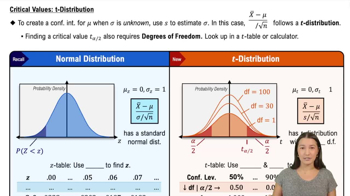
Critical Values: t-Distribution

Level of Confidence

The level of confidence, denoted as 'c', represents the probability that the confidence interval will contain the true population parameter. A common level of confidence is 90%, which implies that if we were to take many samples and construct confidence intervals, approximately 90% of those intervals would contain the true parameter. This level influences the width of the confidence interval.
Recommended video:
06:33
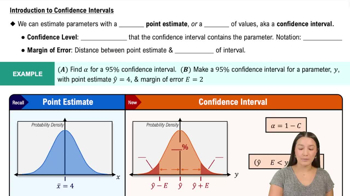
Introduction to Confidence Intervals

Sample Size

Sample size, denoted as 'n', refers to the number of observations or data points collected in a study. It plays a crucial role in statistical analysis, as larger sample sizes generally lead to more reliable estimates of population parameters and narrower confidence intervals. In this case, a sample size of 16 indicates a relatively small sample, which may affect the precision of the confidence interval.
Recommended video:
05:11
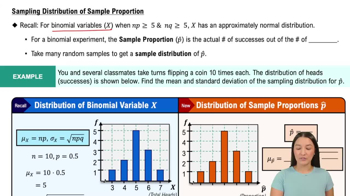
Sampling Distribution of Sample Proportion
Related Practice
Textbook Question

In Exercises 9–12, find the critical value tc for the level of confidence c and sample size n.

c = 0.98, n = 15

111
views

Textbook Question

[APPLET] The waking times (in minutes past 5:00 A.M.) of 40 people who start work at 8:00 A.M. are shown in the table at the left. Assume the population standard deviation is 45 minutes. Find (a) the point estimate of the population mean μ and (b) the margin of error for a 90% confidence interval.

85
views
Textbook Question

[APPLET] The winning times (in hours) for a sample of 20 randomly selected Boston Marathon Women’s Open Division champions from 1980 to 2019 are shown in the table at the left. Assume the population standard deviation is 0.068 hour. (Source: Boston Athletic Association)

b. Find the margin of error for a 95% confidence level.

76
views
Textbook Question

In Exercises 13–16, (a) find the margin of error for the values of c, s, and n, and (b) construct the confidence interval for using the t-distribution. Assume the population is normally distributed.

c = 0.99, s = 16.5, n = 20, xbar = 25.2

80
views
Textbook Question

In a random sample of 12 senior-level civil engineers, the mean annual earnings were \$133,326 and the standard deviation was \$36,729. Assume the annual earnings are normally distributed and construct a 95% confidence interval for the population mean annual earnings for senior-level civil engineers. Interpret the results. (Adapted from Salary.com)

94
views
Textbook Question

You research the salaries of senior-level civil engineers and find that the population mean is \$131,935. In Exercise 4, does the t-value fall between -t0.95 and t0.95?

61
views