Ch. 6 - Confidence Intervals
Larson - Elementary Statistics: Picturing the World 8th Edition
Larson8th EditionElementary Statistics: Picturing the WorldISBN: 9780137493470Not the one you use?Change textbook
Chapter 6, Problem 6.R.5

In Exercises 5 and 6, use the confidence interval to find the margin of error and the sample mean.
(20.75, 24.10)

Verified step by step guidance
1
Step 1: Understand the problem. The confidence interval is given as (20.75, 24.10). The goal is to find the margin of error and the sample mean.
Step 2: Recall the formula for the margin of error. The margin of error (E) is half the width of the confidence interval. Mathematically, this can be expressed as: E = \(\frac{\text{Upper Limit}\) - \(\text{Lower Limit}\)}{2}.
Step 3: Recall the formula for the sample mean. The sample mean is the midpoint of the confidence interval. Mathematically, this can be expressed as: \(\text{Sample Mean}\) = \(\frac{\text{Upper Limit}\) + \(\text{Lower Limit}\)}{2}.
Step 4: Substitute the given values into the formulas. For the margin of error, substitute 24.10 as the upper limit and 20.75 as the lower limit into the formula for E. Similarly, substitute these values into the formula for the sample mean.
Step 5: Simplify the expressions to calculate the margin of error and the sample mean. This will give you the final results for both values.

Verified video answer for a similar problem:

This video solution was recommended by our tutors as helpful for the problem above.
Video duration:
1m
Was this helpful?

Key Concepts

Here are the essential concepts you must grasp in order to answer the question correctly.

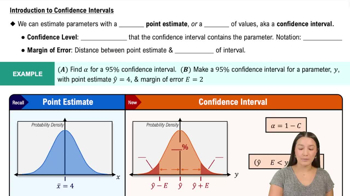
Confidence Interval

A confidence interval is a range of values, derived from sample statistics, that is likely to contain the true population parameter. It is expressed as an interval (e.g., (20.75, 24.10)) and is associated with a confidence level, typically 95% or 99%, indicating the degree of certainty that the interval contains the parameter.
Recommended video:
06:33
Introduction to Confidence Intervals

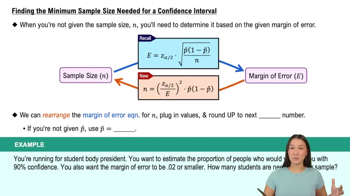
Margin of Error

The margin of error quantifies the uncertainty associated with a sample estimate. It is calculated as half the width of the confidence interval, representing the maximum expected difference between the sample statistic and the population parameter. In this case, it can be found by subtracting the lower limit from the upper limit of the interval and dividing by two.
Recommended video:
04:08
Finding the Minimum Sample Size Needed for a Confidence Interval

Sample Mean

The sample mean is the average of a set of sample observations and serves as a point estimate of the population mean. It can be calculated by taking the midpoint of the confidence interval, which provides a central value around which the interval is constructed. In this example, the sample mean can be found by averaging the two endpoints of the interval.
Recommended video:
05:11
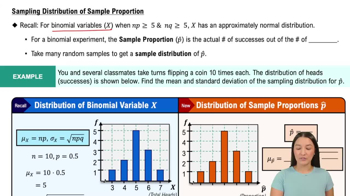
Sampling Distribution of Sample Proportion
Related Practice
Textbook Question

Determine the minimum sample size required to be 95% confident that the sample mean waking time is within 10 minutes of the population mean waking time. Use the population standard deviation from Exercise 1.

113
views

Textbook Question

[APPLET] The waking times (in minutes past 5:00 A.M.) of 40 people who start work at 8:00 A.M. are shown in the table at the left. Assume the population standard deviation is 45 minutes. Find (a) the point estimate of the population mean μ and (b) the margin of error for a 90% confidence interval.

85
views
Textbook Question

In Exercises 13–16, (a) find the margin of error for the values of c, s, and n, and (b) construct the confidence interval for using the t-distribution. Assume the population is normally distributed.

c = 0.99, s = 16.5, n = 20, xbar = 25.2

80
views
Textbook Question

You wish to estimate, with 95% confidence, the population proportion of U.S. adults who have taken or planned to take a winter vacation in a recent year. Your estimate must be accurate within 5% of the population proportion.

b. Find the minimum sample size needed, using a prior study that found that 32% of U.S. adults have taken or planned to take a winter vacation in a recent year. (Source: Rasmussen Reports)

88
views
Textbook Question

In Exercises 19–22, let p be the population proportion for the situation. (a) Find point estimates of p and q, (b) construct 90% and 95% confidence intervals for p, and (c) interpret the results of part (b) and compare the widths of the confidence intervals.

In a survey of 73,901 college graduates, 23,991 obtained a postgraduate degree. (Adapted from Gallup)

96
views
Textbook Question

In Exercises 13–16, (a) find the margin of error for the values of c, s, and n, and (b) construct the confidence interval for using the t-distribution. Assume the population is normally distributed.

c = 0.90, s = 25.6, n = 16, xbar = 72.1

148
views