Graphical Analysis In Exercises 9–12, use the values on the number line to find the sampling error.
Ch. 6 - Confidence Intervals
Larson8th EditionElementary Statistics: Picturing the WorldISBN: 9780137493470Not the one you use?Change textbook
Chapter 6, Problem 6.2.8
In Exercises 7 and 8, find the margin of error for the values of c, s, and n.
c = 0.99, s = 3, n = 6
Verified step by step guidance1
Step 1: Understand the formula for the margin of error (E). The margin of error is calculated using the formula: , where z is the critical value corresponding to the confidence level (c), s is the sample standard deviation, and n is the sample size.
Step 2: Determine the critical value (z) for the given confidence level (c = 0.99). Use a z-table or statistical software to find the z-value that corresponds to a 99% confidence level. For a two-tailed test, this is the z-value where the area in the tails is 0.01 (0.005 in each tail).
Step 3: Plug in the given values for s and n into the formula. Here, s = 3 and n = 6. Substitute these values into the formula: .
Step 4: Simplify the denominator by calculating the square root of the sample size (n). Compute and substitute it into the formula.
Step 5: Multiply the critical value (z) by the fraction to calculate the margin of error (E). This will give you the final result.

Verified video answer for a similar problem:
This video solution was recommended by our tutors as helpful for the problem above.
Video duration:
2mWas this helpful?
Key Concepts
Here are the essential concepts you must grasp in order to answer the question correctly.
Margin of Error
The margin of error quantifies the uncertainty in a statistical estimate. It indicates the range within which the true population parameter is expected to lie, given a certain confidence level. A higher margin of error suggests less precision in the estimate, while a lower margin indicates greater confidence in the results.
Recommended video:
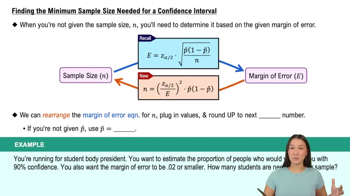
Finding the Minimum Sample Size Needed for a Confidence Interval
Confidence Level
The confidence level represents the probability that the margin of error will capture the true population parameter. Common confidence levels include 90%, 95%, and 99%. In this case, a confidence level of 0.99 means that if the same sampling method were repeated multiple times, 99% of the calculated intervals would contain the true parameter.
Recommended video:
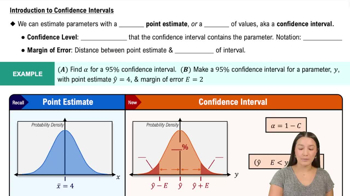
Introduction to Confidence Intervals
Sample Size (n)
Sample size refers to the number of observations or data points collected in a study. A larger sample size generally leads to a smaller margin of error, enhancing the reliability of the estimate. In this context, with n = 6, the sample size is relatively small, which may result in a larger margin of error compared to larger samples.
Recommended video:
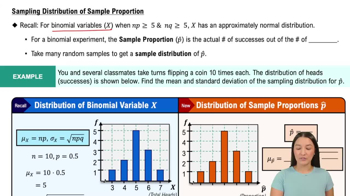
Sampling Distribution of Sample Proportion
Related Practice
Textbook Question
49
views
Textbook Question
Which statistic is the best unbiased estimator for μ?
a. s
b. xbar
c. the median
d. the mode
149
views
Textbook Question
In Exercises 9–12, construct the indicated confidence intervals for (a) the population variance and (b) the population standard deviation . Assume the sample is from a normally distributed population.
c = 0.99, s^2 = 0.64, n = 7
113
views
Textbook Question
In Exercises 7–10, the statement represents a claim. Write its complement and state which is Ho and which is Ha.
μ<33
49
views
Textbook Question
In Exercises 21–24, construct the indicated confidence interval for the population mean μ.
c = 0.95, xbar = 31.39, σ = 0.80, n = 82.
129
views
Textbook Question
In Exercises 29–32, determine the minimum sample size n needed to estimate for the values of c, σ, and E.
c = 0.95, σ = 2.5, E = 1.
100
views