

Ch. 6 - Confidence Intervals
Larson - Elementary Statistics: Picturing the World 8th Edition
Larson8th EditionElementary Statistics: Picturing the WorldISBN: 9780137493470Not the one you use?Change textbook
Chapter 6, Problem 6.T.3d

The data set represents the scores of 12 randomly selected students on the SAT Physics Subject Test. Assume the population test scores are normally distributed and the population standard deviation is 108. (Adapted from The College Board)
<IMAGE>
d. Determine the minimum sample size required to be 95% confident that the sample mean test score is within 10 points of the population mean test score.

Verified step by step guidance
1
Step 1: Identify the formula for minimum sample size calculation. The formula is: n=(zcσp/E)^2, where zc is the z-score corresponding to the confidence level, σp is the population standard deviation, and E is the margin of error.
Step 2: Determine the z-score for a 95% confidence level. For a 95% confidence level, the z-score is approximately 1.96. This value is derived from standard normal distribution tables.
Step 3: Substitute the given values into the formula. The population standard deviation σp is 108, and the margin of error E is 10. Plug these values into the formula: n=(1.96108/10)^2.
Step 4: Simplify the expression inside the parentheses. First, calculate 1.96108/10. Then square the result to find the value of n.
Step 5: Round up the result to the nearest whole number. Since sample size must be a whole number, always round up to ensure the margin of error is within the specified range.

Verified video answer for a similar problem:

This video solution was recommended by our tutors as helpful for the problem above.
Video duration:
1m
Was this helpful?

Key Concepts

Here are the essential concepts you must grasp in order to answer the question correctly.

Sample Size Determination

Sample size determination is the process of calculating the number of observations or replicates needed in a statistical study to ensure that the results are reliable and valid. In this context, it involves using the desired confidence level and margin of error to find the minimum number of students needed to estimate the population mean accurately.
Recommended video:
Guided course
06:14
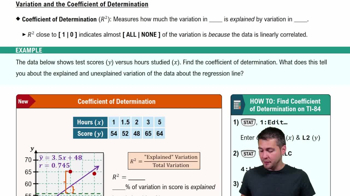
Coefficient of Determination

Confidence Interval

A confidence interval is a range of values, derived from a data set, that is likely to contain the true population parameter with a specified level of confidence. For example, a 95% confidence interval means that if we were to take many samples, approximately 95% of those intervals would contain the true population mean, providing a measure of uncertainty around the estimate.
Recommended video:
06:33
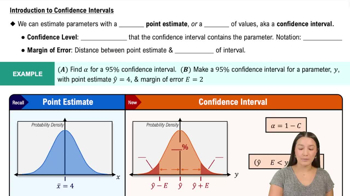
Introduction to Confidence Intervals

Normal Distribution

Normal distribution is a probability distribution that is symmetric about the mean, showing that data near the mean are more frequent in occurrence than data far from the mean. In this scenario, the assumption of normality allows the use of specific statistical methods to calculate the sample size and confidence intervals, as many statistical techniques rely on this distribution.
Recommended video:
06:23
Using the Normal Distribution to Approximate Binomial Probabilities
Related Practice
Textbook Question

The data set represents the scores of 12 randomly selected students on the SAT Physics Subject Test. Assume the population test scores are normally distributed and the population standard deviation is 108. (Adapted from The College Board)

b. Construct a 90% confidence interval for the population mean. Interpret the results.

74
views
Textbook Question

The data set represents the weights (in pounds) of 10 randomly selected black bears from northeast Pennsylvania. Assume the weights are normally distributed. (Source: Pennsylvania Game Commission)

c. Construct a 99% confidence interval for the population standard deviation. Interpret the results.

95
views
Textbook Question

Since 1935, the Gallup Organization has conducted public opinion polls in the United States and around the world. The table shows the results of Gallup’s World Affairs Poll of 2021, in which 1021 U.S. adults were polled. The remaining percentages not shown in the results are adults who were not sure.

[IMAGE]

Find the minimum sample size needed to estimate, with 95% confidence, the population proportion of adults who feel that China’s economic power is a critical or an important economic threat to the United States. Your estimate must be accurate within 2% of the population proportion.

42
views
Textbook Question

In a survey of 2096 U.S. adults, 1740 think football teams of all levels should require players who suffer a head injury to take a set amount of time off from playing to recover. (Adapted from The Harris Poll)

b. Construct a 95% confidence interval for the population proportion. Interpret the results.

88
views
Textbook Question

The data set represents the scores of 12 randomly selected students on the SAT Physics Subject Test. Assume the population test scores are normally distributed and the population standard deviation is 108. (Adapted from The College Board)

c. Would it be unusual for the population mean to be under 575? Explain.

81
views
Textbook Question

Since 1935, the Gallup Organization has conducted public opinion polls in the United States and around the world. The table shows the results of Gallup’s World Affairs Poll of 2021, in which 1021 U.S. adults were polled. The remaining percentages not shown in the results are adults who were not sure.

Use technology to find a 95% confidence interval for the population proportion of adults who

a. view foreign trade as an economic opportunity.

36
views