Ch. 6 - Confidence Intervals
Larson - Elementary Statistics: Picturing the World 8th Edition
Larson8th EditionElementary Statistics: Picturing the WorldISBN: 9780137493470Not the one you use?Change textbook
Chapter 6, Problem 6.3.30

Translating Statements In Exercises 29–34, translate the statement into a confidence interval. Approximate the level of confidence.
In a survey of 220 U.S. adults ages 18–29, 65% said that they use Snapchat. The survey’s margin of error is ±7.9%. (Source: Pew Research Center)

Verified step by step guidance
1
Identify the sample proportion (p̂) from the problem. Here, 65% of the surveyed adults use Snapchat, so p̂ = 0.65.
Determine the margin of error (ME) provided in the problem. The margin of error is ±7.9%, which can be written as ME = 0.079.
Construct the confidence interval using the formula: Confidence Interval = p̂ ± ME. This means the lower bound of the interval is p̂ - ME, and the upper bound is p̂ + ME.
Substitute the values into the formula: Lower Bound = 0.65 - 0.079 and Upper Bound = 0.65 + 0.079. This will give the range of the confidence interval.
Approximate the level of confidence. The margin of error is typically associated with a 95% confidence level unless otherwise stated. Therefore, the confidence level is approximately 95%.

Verified video answer for a similar problem:

This video solution was recommended by our tutors as helpful for the problem above.
Video duration:
4m
Was this helpful?

Key Concepts

Here are the essential concepts you must grasp in order to answer the question correctly.

Confidence Interval

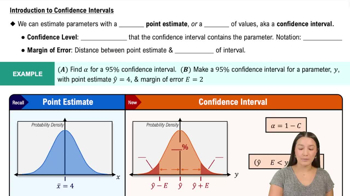
A confidence interval is a range of values, derived from sample statistics, that is likely to contain the true population parameter. It is expressed as an interval estimate, typically calculated as the sample proportion plus or minus the margin of error. For example, if 65% of respondents use Snapchat and the margin of error is ±7.9%, the confidence interval would be from 57.1% to 72.9%.
Recommended video:
06:33
Introduction to Confidence Intervals

Margin of Error

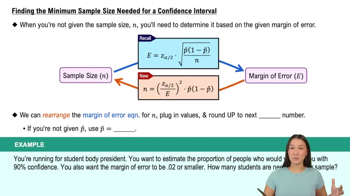
The margin of error quantifies the uncertainty associated with a sample estimate. It indicates the range within which the true population parameter is expected to lie, based on the sample data. In this case, a margin of error of ±7.9% means that the true percentage of Snapchat users in the population could be 7.9% higher or lower than the sample estimate of 65%.
Recommended video:
04:08
Finding the Minimum Sample Size Needed for a Confidence Interval

Level of Confidence

The level of confidence reflects the degree of certainty that the true population parameter lies within the confidence interval. Common levels of confidence are 90%, 95%, and 99%. The level of confidence is typically associated with the margin of error; for instance, a 95% confidence level is often used in surveys, suggesting that if the survey were repeated multiple times, 95% of the calculated intervals would contain the true parameter.
Recommended video:
06:33
Introduction to Confidence Intervals
Related Practice
Textbook Question

In Exercises 13 and 14, use the confidence interval to find the margin of error and the sample mean.

(14.7, 22.1)

95
views

Textbook Question

In Exercises 29–32, determine the minimum sample size n needed to estimate for the values of c, σ, and E.

c = 0.90, σ = 6.8, E = 1.

148
views
Textbook Question

In Exercises 35–40, use the standard normal distribution or the t-distribution to construct a 95% confidence interval for the population mean. Justify your decision. If neither distribution can be used, explain why. Interpret the results.

In a random sample of 18 months from January 2011 through December 2020, the mean interest rate for 30-year fixed rate home mortgages was 3.95% and the standard deviation was 0.49%. Assume the interest rates are normally distributed. (Source: Freddie Mac)

101
views
Textbook Question

Translating Statements In Exercises 29–34, translate the statement into a confidence interval. Approximate the level of confidence.

In a survey of 1000 U.S. adults, 71% think teaching is one of the most important jobs in our country today. The survey’s margin of error is ±3%. (Source: Rasmussen Reports)

88
views
Textbook Question

Finding Critical Values for χ2 In Exercises 3–8, find the critical values χR2 and χL2 for the level of confidence c and sample size n.

c = 0.99, n = 15

73
views
Textbook Question

Finding Critical Values for χ2 In Exercises 3–8, find the critical values χR2 and χL2 for the level of confidence c and sample size n.

c = 0.80, n = 51

61
views