

Ch. 6 - Confidence Intervals
Larson - Elementary Statistics: Picturing the World 8th Edition
Larson8th EditionElementary Statistics: Picturing the WorldISBN: 9780137493470Not the one you use?Change textbook
Chapter 6, Problem 6.3.35

Why Check It? Why is it necessary to check that np^ ≥ 5 and nq^ ≥ 5?

Verified step by step guidance
1
The condition np̂ ≥ 5 and nq̂ ≥ 5 is used to ensure that the sampling distribution of the sample proportion p̂ is approximately normal. This is important because many statistical methods, such as hypothesis testing and confidence intervals, rely on the assumption of normality.
Here, n represents the sample size, p̂ is the sample proportion, and q̂ = 1 - p̂ is the complement of the sample proportion. These conditions ensure that there are enough successes (np̂) and failures (nq̂) in the sample to approximate a normal distribution.
When np̂ and nq̂ are both at least 5, the Central Limit Theorem applies, which states that the sampling distribution of p̂ will be approximately normal, regardless of the shape of the population distribution.
If these conditions are not met (i.e., np̂ < 5 or nq̂ < 5), the sampling distribution may be skewed or not well-approximated by a normal distribution, leading to inaccurate results in statistical inference.
To summarize, checking these conditions ensures the validity of using normal approximation methods for proportions, which is a critical step in solving problems involving proportions in statistics.

Verified video answer for a similar problem:

This video solution was recommended by our tutors as helpful for the problem above.
Video duration:
1m
Was this helpful?

Key Concepts

Here are the essential concepts you must grasp in order to answer the question correctly.

Binomial Distribution

The binomial distribution models the number of successes in a fixed number of independent Bernoulli trials, each with the same probability of success. It is characterized by two parameters: n (the number of trials) and p (the probability of success). Understanding this distribution is crucial for determining when certain statistical methods can be applied.
Recommended video:
Guided course
03:28
Mean & Standard Deviation of Binomial Distribution

Normal Approximation

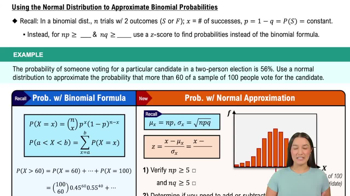
The normal approximation to the binomial distribution allows us to use the normal distribution to estimate probabilities for binomial outcomes when certain conditions are met. Specifically, the conditions np ≥ 5 and nq ≥ 5 ensure that the distribution is sufficiently symmetric and bell-shaped, making the approximation valid.
Recommended video:
06:23
Using the Normal Distribution to Approximate Binomial Probabilities

Central Limit Theorem

The Central Limit Theorem states that the sampling distribution of the sample mean will approach a normal distribution as the sample size increases, regardless of the original distribution of the data. This theorem underpins the rationale for checking the conditions np ≥ 5 and nq ≥ 5, as it guarantees that the sampling distribution will be approximately normal under these conditions.
Recommended video:
Guided course
04:52
Calculating the Mean